High-Density Deep Lane Racking Systems
Explore our certified heavy-duty storage configurations designed for maximum cubic footprint utilization and high-throughput material handling.
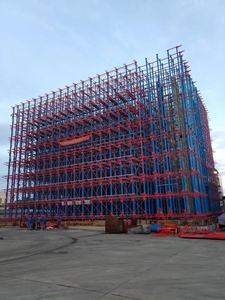
Pallet Shuttle Rack Deep Lane Storage & Retrieval System
Semi-automated radio shuttle configuration optimizing deep-lane storage capacity up to 85% volume utilization.
Send an Inquiry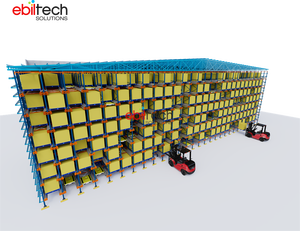
CE Certified Two-Way Shuttle Integrated Rack Clad System
High-bay clad structure engineered for deep lane warehouse integration with structural integrity compliance.
Send an Inquiry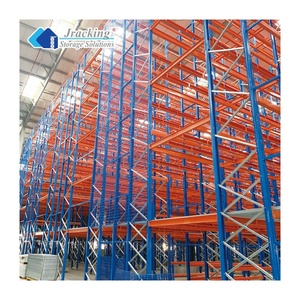
EU Standard Heavy-Duty Pallet Racking for Logistics Hubs
FEM 10.2.02 and EN 15512 compliant selective rack frames tailored for high-frequency distribution hubs.
Send an Inquiry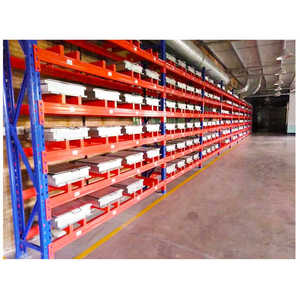
Direct Factory High-Density Drive-In Steel Narrow Lane Rack
Maximized block storage density removing aisle requirements for homogeneous bulk inventory operations.
Send an Inquiry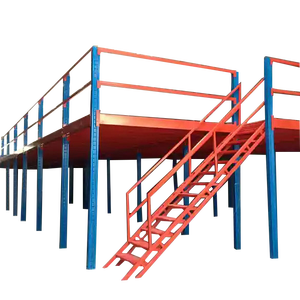
Custom Heavy-Load 2-Layer Steel Mezzanine Floor Rack
ISO 9001/CE certified rack-supported platform expanding vertical cubic floor space efficiently.
Send an Inquiry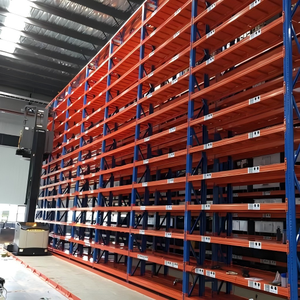
Heavy-Duty VNA Narrow Lane High Bay Racking (500-4000kg)
Precision-engineered aisle guide rails delivering 100% pallet selectivity at extreme vertical heights.
Send an Inquiry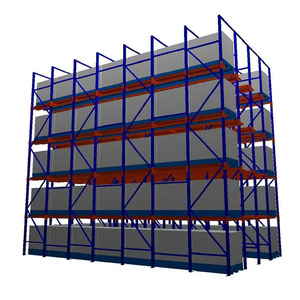
Heavy-Duty Forklift Lane Storage Drive-In Racking System
Reinforced cantilever arm support system designed for high-tonnage pallet stacking stability.
Send an Inquiry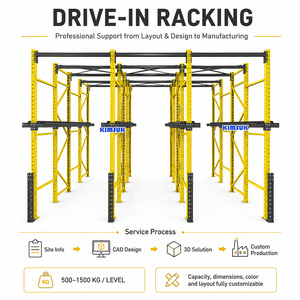
Extendable Modular Lane Pallet Rack System for Future Expansion
Scalable grid framing allowing seamlessly expandable deep-lane lanes as warehouse volume scales.
Send an InquiryModern Deep Lane Storage Engineering: Balancing Density, Throughput, and TCO
As global supply chains navigate surging land acquisition costs and shifting inventory velocity requirements, facility managers must re-evaluate traditional wide-aisle selective storage frameworks. Deep Lane Storage Racking Systems—encompassing Radio Shuttle Racking, Drive-In, Push-Back, and Automated Storage and Retrieval Systems (ASRS)—represent a architectural paradigm shift. By eliminating unnecessary forklift access corridors, deep-lane systems reclaim up to 60% of dead aisle space, converting unutilized cubic volume into dynamic revenue-generating pallet storage positions.
Engineering Information Gain: The Cubic Storage Formula
Effective Volume Optimization Ratio ($V_{eff}$) is calculated as:
V_eff = (N_pallets × V_unit) / (A_facility × H_clear)
While standard selective rack systems max out at $V_{eff} \approx 0.35 - 0.42$, modern shuttle-driven deep lane systems regularly achieve $V_{eff} \ge 0.75 - 0.82$, effectively doubling inventory holding capacity without expanding structural facility footprint.
To achieve top structural performance, modern racking systems rely on precision cold-rolled structural Q235B and Q355B high-tensile steel alloys. Beam deflections must strictly abide by international standards such as FEM 10.2.02 (European Federation of Materials Handling) and EN 15512, limiting max deflection to under L/200 under full safe working load (SWL).
Deep Lane Storage Systems Comparison Matrix
A data-backed technical comparison to guide procurement teams based on SKU diversity, stock rotation rules (FIFO/LIFO), and CapEx efficiency.
| Storage Racking System | Cubic Density | Access Protocol | Pallet Selectivity | Forklift Damage Risk | CapEx Index |
|---|---|---|---|---|---|
| Radio Shuttle Racking | Ultra-High (85%) | FIFO or LIFO | Lane Level | Low (Exterior Work) | Medium-High |
| Drive-In / Drive-Through | High (75%) | Strict LIFO | System Level | High (Inside Aisle) | Economical |
| Push-Back (Cart/Roller) | Medium-High (65%) | LIFO (2-6 Deep) | Level/Lane | Low (Face Load) | Moderate |
| Pallet Flow (Gravity) | High (80%) | Strict FIFO | Lane Level | Very Low | High (Mechanical) |
| VNA (Very Narrow Aisle) | Medium (55%) | Random Access | 100% Direct | Medium (Guided) | Moderate |
| 4-Way Shuttle ASRS | Maximum (92%) | WMS Fully Automated | 100% Dynamic | Zero (Unmanned) | Enterprise High |
Core Technological Pillars of Trusted Manufacturers
Evaluating structural integrity, electronic automation reliability, and metallurgical compliance when qualifying global OEM suppliers.
Advanced Roll-Forming Metallurgy
Top-tier manufacturers utilize continuous 18-stage cold roll-forming machines to craft structural upright profiles with complex multi-rib cross-sections (omega & tear-drop patterns). High-yield steel alloys (Q355B grade) guarantee high resistance against dynamic impact torsional stress.
Smart Shuttle Battery & Wireless PLC
Modern radio shuttles utilize industrial Lithium Iron Phosphate (LiFePO4) power cells with fast charging cycle capabilities (30-minute charge for 8-hour continuous shifts). Integrated 2.4GHz/5GHz Wi-Fi modules sync directly with Warehouse Control Systems (WCS) for real-time lane positioning.
Anti-Seismic & Load Deflection Design
Engineered framing systems include non-linear finite element structural analysis (FEA) to withstand seismic activity under ANSI MH16.1 specifications. Heavy-duty baseplates, floor expansion anchors, and dynamic top braces distribute dynamic floor shear stress evenly.
Key Procurement & Technology Trends Shaping Deep Lane Racking
Global supply chain strategies are turning toward intelligent automation, sustainable manufacturing, and resilient cold-chain integration. Procurement directors evaluating long-term infrastructure assets must account for several major technology trends currently reshaping the deep-lane storage landscape:
1. Transition to 4-Way Autonomous Shuttles
While traditional 2-way radio shuttles travel only forwards and backwards within designated channels, 4-way shuttles can change lanes independently via specialized cross-rail networks, drastically reducing system dependence on forklift operations.
2. Cryogenic Sub-Zero Cold-Chain Optimization
Cold storage energy costs continue to escalate. High-density shuttle systems operating down to -30°C reduce conditioned volume loss by up to 50%, while specialized low-temperature battery chemistries prevent voltage drops during extended freeze cycles.
3. Digital Twins & Predictive Maintenance
Advanced racking systems incorporate embedded IoT strain gauges and optical sensor arrays. Integrated WMS platforms model physical stress in real time, alerting facilities to structural impacts or track alignment drift long before failures occur.
Remprack Storage Solutions Infrastructure
Delivering engineered quality, certified safety standards, and reliable structural performance for global enterprise projects.
Strict International Quality & Compliance Standard
Every pallet racking frame, beam component, and automated shuttle carriage leaving our factory undergoes rigorous quality inspection protocols. Our production workflows strictly implement ISO 9001 quality management systems and ISO 14001 environmental safety controls.
All physical steel structural elements hold formal CE Certification and third-party compliance verification from TÜV Rheinland. From salt-spray corrosion resistance tests (exceeding 500 hours under ASTM B117 standards) to destructive ultrasonic weld inspections, our engineering team ensures your project meets or exceeds local building codes and seismic mandates across Europe, the Americas, Asia, and the Middle East.
Frequently Asked Procurement Questions
In-depth technical answers addressing structural engineering, slab requirements, and total operational cost factors.
What floor slab specifications (load-bearing & flatness) are required for deep-lane shuttle racking?
How does a Radio Shuttle deep lane system compare to traditional Drive-In racking regarding ROI and safety?
What thermal and electrical considerations are necessary for sub-zero cold storage installations (-25°C)?
How do you calculate dynamic safety factors and beam deflection limits under European FEM standards?
\delta \le L / 200 (where $L$ represents clear beam span length). Upright frames are subjected to axial compression loading calculations incorporating global buckling modes and pattern load scenarios.
Can existing standard selective or Drive-In racking frames be retrofitted into Radio Shuttle deep lane systems?
What OEM/ODM customization options and compliance documentation are provided for international shipments?
Request a Custom Deep Lane Racking Layout & Structural Quote
Send your warehouse floor plans (CAD/PDF), clear height specs, and pallet load data to our senior structural engineering team for a full ROI analysis and layout proposal.