High-Rise Warehouse Racking Architectural Standard & Sourcing Landscape
A comprehensive analysis of load-bearing structural design, FEM/EN standards compliance, vertical height optimization, and total cost of ownership (TCO) for global B2B procurement leaders.
In modern industrial logistics, vertical storage optimization has shifted from an operational advantage to an absolute architectural necessity. Urban industrial land prices, rising construction costs per square meter, and the explosion of global SKU counts demand that distribution hubs scale upward rather than outward. High-rise pallet racking systems—spanning heights from 12 meters to over 40 meters in Automated Storage and Retrieval Systems (ASRS)—represent the pinnacle of structural racking engineering.
This industry white paper serves as an authoritative evaluation guide for enterprise logistics directors, supply chain consultants, and engineering procurement teams. Achieving structural equilibrium in high-bay steel racking requires rigorous adherence to European standards (EN 15512, EN 15620), American Rack Manufacturers Institute (ANSI/RMI MH16.1) guidelines, and international FEM specifications (specifically FEM 10.2.02). Factories producing high-rise systems must maintain mill-level precision during cold roll-forming of high-yield steel structural members (such as Q355B and Q460 structural steel), ensuring tight vertical deflection tolerances, seismic damping integrity, and dynamic sway stability under heavy payload cycles.
Top Recommended High-Rise Pallet Racking & Automation Systems
Direct factory equipment engineered for maximum structural density, forklift accessibility, and automated shuttle integration.
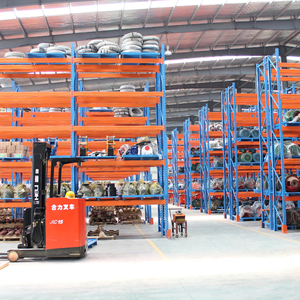
Best Selling Customized Warehouse Drive in Rack Steel Pallet Racking System Heavy Duty Industrial Warehouse Steel Rack
Engineered for high-density bulk storage eliminating aisle space. Designed with continuous upright frames allowing forklifts to drive directly into rack lanes. Ideal for homogenous inventory with high pallet counts per SKU.
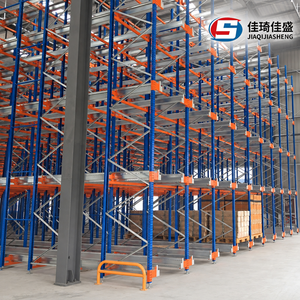
Multi-Level Automatic Warehouse Racking River-Type Pallet Two-way Radio Shuttle Rack for Storage Iron Steel Material
Heavy-duty semi-automated shuttle racking configured for dense steel raw material and heavy industrial inventory. Features high-load wireless radio shuttles navigating custom roll-formed guide rails with automatic position control.
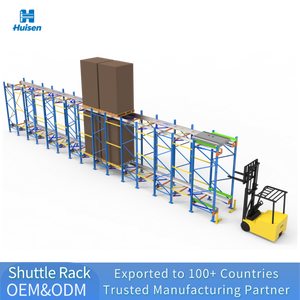
Shuttle Racking System High Density Pallet Storage Automated Warehouse Deep Lane Rack Custom Manufacturer Factory Direct
Deep-lane radio shuttle storage solution supporting both FIFO and LIFO operational modes. Maximizes vertical and depth space utilization while drastically reducing forklift turn-times and operator handling risks in high-throughput centers.
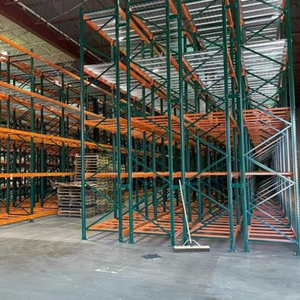
Telescopic Reach Truck Matching Adjustable Step Beam Mass Stock Distribution Center Double Deep Steel Pallet Racking Narrow
Double-deep selective rack architecture paired with specialized pantograph or telescopic reach trucks. Increases storage density by up to 30% compared to standard single-deep racking while preserving flexible SKU access.
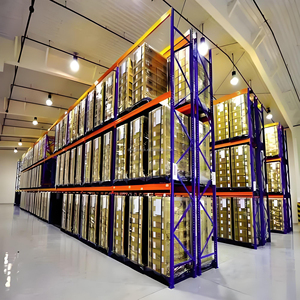
Space Saving Warehouse Storage Solution Forklift Entry System High Density Drive in Rack
Compact architectural footprint optimized for cold storage, chemical staging, and bulk beverage storage. Features continuous cantilever arms, floor alignment rails, and heavy-duty upright column guards for forklift safety.
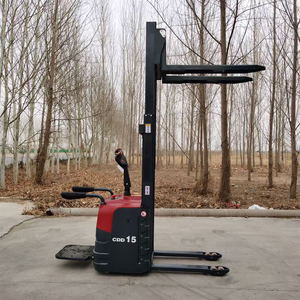
Hot Selling Walk Behind Electric Stacker 1.5ton 2ton Electric Forklift Stacker Electric Pallet Stacker
Industrial electric pallet stacker designed for narrow aisle navigation, staging area loading, and low-to-medium height pallet positioning. Features AC drive control, ergonomic tiller handles, and robust mast stability systems.
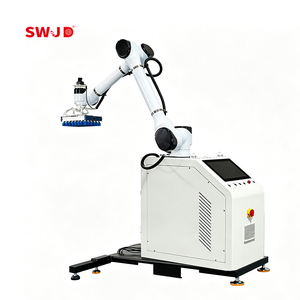
Automatic Palletizer Robot M50 With 50kg Payload Robot Palletizer For Warehouse Automation Integrated Handling System
High-precision 4-axis industrial robotic palletizer with 50kg payload capability. Integrates seamlessly into automated high-bay conveyor feeds, stacking cartons, totes, or bags with pinpoint accuracy prior to rack storage.
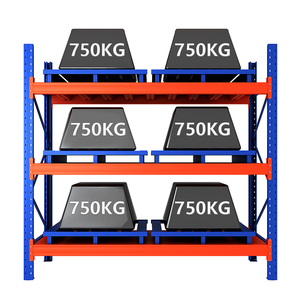
High Load Capacity Heavy Duty VNA Pallet Racks for Warehouse Storage Steel/Metal for Use with Forklift Trucks Save Space
Very Narrow Aisle (VNA) racking engineered for extreme vertical heights up to 18+ meters. Reduces aisle widths down to 1.5–1.8m when operated with wire-guided or rail-guided turret trucks, maximizing cubic space efficiency.
Technological Evolution of High-Bay Pallet Racking Systems
From static beam framing to intelligent, automated, high-yield steel infrastructure.
Advanced Roll-Forming Metallurgy
Modern high-rise upright profiles utilize multi-stage cold roll-forming machines with integrated continuous laser punch indexing. Utilizing high-strength cold-rolled steel (e.g., Q355B, Q460), manufacturers achieve higher section modulus and torsional rigidity without adding unnecessary dead load to the slab floor.
4-Way Automated Radio Shuttles
Moving beyond standard 2-way shuttle channels, 4-way shuttle systems navigate both longitudinal storage lanes and transverse transfer aisles. Equipped with onboard LiDAR sensors, optical encoders, and brushless DC motors, 4-way shuttles dynamically interface with vertical lifts to form fully autonomous high-bay networks.
Seismic Damping & Finite Element Analysis (FEA)
High-bay structures require sophisticated FEA simulations to calculate structural displacement under lateral shear forces, seismic accelerations, and asymmetric live loads. Dynamic base-plate anchoring systems, structural bracing trusses, and energy-dissipating friction dampers ensure seismic safety compliance globally.
The engineering progression of high-rise pallet racking has effectively bridged the gap between structural civil engineering and mechatronic automation. In high-bay installations exceeding 20 meters, racking frames often function as the primary load-bearing structure for the warehouse building itself—a system known as Rack-Supported Buildings (Clad-Rack Infrastructure). In clad-rack construction, the side wall cladding and roof trusses attach directly onto the steel racking frames, eliminating the need for independent structural steel building columns and drastically reducing total real estate capitalization costs.
Future Procurement Trends in High-Bay Intralogistics
Key technological shifts shaping enterprise equipment investments over the next decade.
Global procurement teams evaluating high-rise racking manufacturers must look beyond initial hardware costs to analyze multi-year operational efficiency, environmental footprint, and technological compatibility. Key trends transforming the procurement landscape include:
1. Decarbonized & Recycled Green Steel Sourcing
Multinational enterprise buyers now mandate low-carbon steel mill certifications (Scope 1 and Scope 2 emissions reporting). Leading China-based export manufacturers are adopting electric arc furnace (EAF) steel coils and eco-friendly thermosetting electrostatic powder coating processes free from volatile organic compounds (VOCs).
2. IoT Structural Health Monitoring (SHM)
High-bay racks are increasingly fitted with strain gauges, shock sensors, and tilt sensors linked to warehouse management software (WMS). These IoT nodes continuously monitor frame deflection, detect forklift impact events in real-time, and execute predictive maintenance alerts prior to structural failure risks.
3. Ultra-Dense Cold-Chain Optimization
With refrigerated warehouse energy consumption being a key cost factor, high-rise shuttle and mobile rack solutions are replacing standard selective racks in cold rooms. By minimizing ambient air volume per pallet, operators save up to 40% in refrigeration thermal loss.
Industrial Pallet Racking Selection & Engineering Matrix
Comparative technical benchmark across primary high-density and selective storage configurations.
| Racking Architecture Type | Max Storage Height | Storage Density Index | Pallet Selectivity | Floor Space Utilization | Automation Readiness | Typical Application |
|---|---|---|---|---|---|---|
| Selective Pallet Racking | Up to 12 meters | Moderate (40-50%) | 100% Direct Access | 40% Floor Coverage | Manual / AGV Forklifts | General Logistics, Mixed SKUs |
| VNA (Very Narrow Aisle) | Up to 18+ meters | High (65-75%) | 100% Direct Access | 65% Floor Coverage | Semi-Automated Turret Trucks | E-commerce, High-Bay Distribution |
| Drive-In / Drive-Through | Up to 12 meters | Very High (75-85%) | Low (LIFO / FIFO Lanes) | 80% Floor Coverage | Manual Forklifts | Seasonal Bulk Goods, Cold Stores |
| 2-Way / 4-Way Radio Shuttle | Up to 25 meters | Ultra High (85-90%) | Lane-Selective (LIFO/FIFO) | 85% Floor Coverage | High (Radio Shuttle Vehicles) | Food & Beverage, Deep-Lane Cold Chain |
| ASRS High-Bay Rack (Clad) | Up to 40+ meters | Maximum (90-95%) | 100% Automated Access | 90% Floor Coverage | Fully Automated (Crane / Shuttle) | 24/7 Smart Automated Logistics Centers |
| Double Deep Pallet Racks | Up to 12 meters | High (60-68%) | 50% Direct Access | 60% Floor Coverage | Specialized Reach Trucks | Manufacturing WIP, Staging Warehouses |
Enterprise Strengths & Global Manufacturing Capabilities
Why Remprack Storage Solutions Co., Ltd. is trusted by international logistics integrators and Fortune 500 brands.
Founded in 2006 in Nanjing, China, Remprack Storage Solutions Co., Ltd. has established itself as an authoritative global manufacturer and exporter of heavy-duty industrial warehouse racking systems. Operating a modern 40,000 square meter production facility powered by over 300 skilled engineers and fabrication specialists, Remprack delivers factory-direct engineering, custom structural design, and international logistics execution.
Remprack's production infrastructure includes automated cold roll-forming production lines, robotic welding work cells, automated continuous powder coating lines, and rigorous in-house mechanical testing labs. Certified to CE, ISO 9001, ISO 14001, and TUV international quality standards, Remprack racking systems have been successfully exported to more than 85 countries across Europe, North America, South America, Southeast Asia, the Middle East, and Africa.
Full OEM & ODM Customization
Tailor-engineered upright profiles, beam box sections, teardrop or beam connector patterns, custom RAL powder coating, and private-label brand packaging for regional racking distributors.
Strict Quality Control & Traceability
Every steel batch undergoes tensile testing, weld seam ultrasonic inspection, and powder paint adhesion cross-hatch testing. Mill test certificates (MTC) are attached to every export shipment.
Comprehensive Export Support
Export packaging optimized for container loading with plastic film wrapping, steel banding, and corner protectors to ensure zero transport damage during ocean transit.
Frequently Asked Questions (FAQ) for High-Rise Racking Procurement
Essential structural, engineering, certification, and export guidelines for international buyers.
Request a Custom High-Rise Racking Layout & Engineering Proposal
Connect directly with Remprack's senior structural engineers to optimize your warehouse layout, evaluate pallet density options, and receive a competitive factory-direct quote.