Technical Whitepaper: High Bay Pallet Racking Structural Architecture & OEM Standards
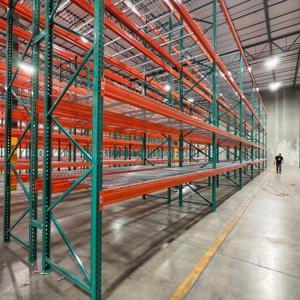
In modern distribution centers, automated logistics facilities, and cold storage hubs, vertical spatial efficiency is no longer optional—it is a critical economic imperative. As a premier Custom OEM High Bay Pallet Racking Manufacturer & Exporters, we engineer ultra-tall racking infrastructure capable of ascending beyond 40 meters in clad-rack applications and over 24 meters in free-standing high-bay installations. Achieving structural integrity at these heights requires a fundamental departure from off-the-shelf shelving. It demands advanced FEA structural modeling, precise cold-formed structural steel selection (Q235B, Q355B, and SS400 grades), and rigorous compliance with international structural standards including FEM 10.2.02, EN 15512, RMI (MH16.1), and AS4084-2012.
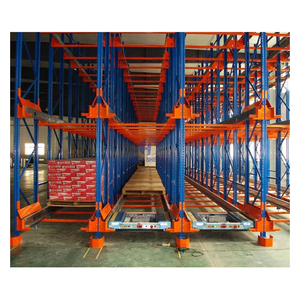
Standard selective racking systems operate primarily under static compression and modest local bending moments. In contrast, High Bay Pallet Racks (whether integrated into AS/RS stacker crane systems, Very Narrow Aisle [VNA] layouts, or automated 4-way shuttle tracks) act as heavy-duty load-bearing skeletons. In rack-supported buildings (clad racks), the racking framework actively supports the roof trusses, side wall cladding, wind loads, snow loads, and seismic shear forces. Consequently, material selection, perforation geometry tolerances, and beam-to-upright lock connector physics must be held to millimeter-exact standards during production.
Upright Profile Engineering
Continuous cold-rolled 11 to 15-fold upright section geometries engineered for maximum buckling resistance under extreme axial load combinations.
Self-Locking Beam Connectors
Precision-stamped 4 or 5-hook connector brackets with automatic drop-out prevention safety pins, eliminating beam dislodgement risks.
Seismic & Wind Resistance
Custom dynamic vibration dampers, heavy-duty baseplates, and high-tensile anchor bolts designed in accordance with local zone accelerations.
Structural & Operational Comparison Matrix
Selecting the correct high-density or high-bay racking system requires balancing space utilization, throughput speed, selectivity, and capital outlay. The table below outlines key technical parameters across our primary OEM structural offerings:
| Racking System Type | Max Height (m) | Pallet Capacity Density | Selectivity Rate | Forklift / Automation Interface | Structural Standard Compliance |
|---|---|---|---|---|---|
| High Bay AS/RS Racking | Up to 45m | Ultra High (85-90%) | 100% Automated | Stacker Cranes / WMS Control | FEM 10.2.02, EN 15512, ISO 9001 |
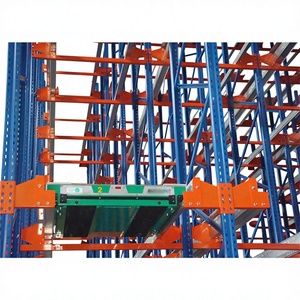
| Radio Shuttle High Bay | Up to 24m | Very High (80-85%) | Lane Selective (LIFO/FIFO) | Motorized Pallet Shuttles + Forklift | CE, TUV, RMI (MH16.1) |
| VNA (Very Narrow Aisle) | Up to 18m | High (70-75%) | 100% Direct Access | VNA Turret Trucks / Rail Guided | EN 15512, FEM 10.2.02 |
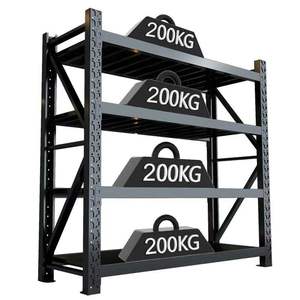
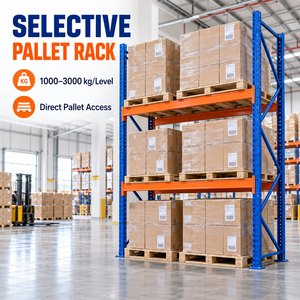
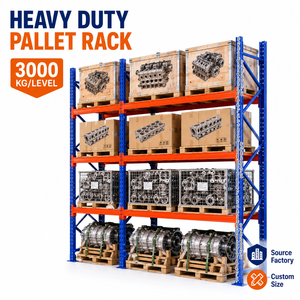
| Heavy-Duty Selective Pallet | Up to 12m | Medium (50-60%) | 100% Direct Access | Standard Reach / Counterbalance | ISO 9001, RMI, AS4084 |
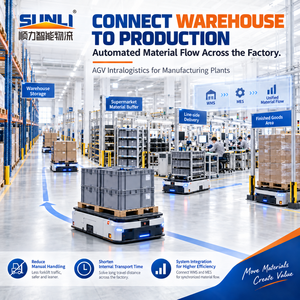
| Rack-Supported Clad Building | Up to 40m+ | Maximum (92%) | Fully Custom WMS Automated | Stacker Crane & AGV Integrated | FEM 10.2.02, EN 1993 (Eurocode 3) |
Future Procurement Trends: Automated High Bay & Smart Storage Systems (2025–2030)
As global supply chains face escalating real estate acquisition costs, labor shortages, and stringent ESG (Environmental, Social, and Governance) targets, procurement managers and logistics architects are shifting their purchasing strategies. Understanding these macro trends is vital for enterprise buyers seeking to future-proof their capital equipment investments:
1. Dark Warehousing & Total Automation
Procurement is rapidly migrating toward "Dark Warehouses"—facilities operating completely unlit and unheated, powered by 24/7 autonomous robotics. High-bay pallet racking must now meet sub-millimeter installation tolerances to accommodate high-speed Autonomous Mobile Robots (AMRs), automated 4-way shuttles, and vision-guided stacker cranes.
2. Cold Chain High-Density Optimization
Energy efficiency in refrigerated and deep-freeze logistics (-25°C to -30°C) is driving high-bay shuttle adoption. By eliminating wasted aisle space, high-bay shuttle systems reduce the total cubic meter footprint requiring refrigeration, lowering operational power consumption by up to 40%.
3. Low-Carbon Green Steel & Eco-Coatings
Enterprise buyers are evaluating the embodied carbon footprint of structural steel equipment. Future-ready manufacturers utilize zero-VOC epoxy-polyester powder coating lines, closed-loop water recovery systems, and recyclable high-tensile steel alloys with full Environmental Product Declarations (EPDs).
Engineering Evolution: From Manual Racking to Intelligent High Bay Infrastructures
The manufacturing evolution of warehouse racking has transformed traditional storage frames into intelligent structural platforms. Below is the historical trajectory and structural advancement engineered into our modern OEM product lines:
Modern OEM customization involves rigorous manufacturing process engineering:
- Phase 1: Automated Slitting & Roll Forming: High-precision uncoiling of premium Q355B structural steel coils, undergoing multi-stage progressive cold-roll forming to create optimized profile sections with internal reinforcing ribs.
- Phase 2: Robotic Laser Welding & Fabrication: Heavy-duty beam connector brackets and baseplates are joined using multi-axis robotic MAG welding stations, eliminating human error and guaranteeing total penetration welds.
- Phase 3: Surface Pre-treatment & Electrostatic Coating: 9-stage automatic chemical washing, degreasing, zinc-phosphating, and nano-ceramic pre-treatment followed by thermosetting powder coating baked at 200°C for exceptional impact and abrasion resistance.
- Phase 4: Full-Scale Load Testing Verification: Continuous structural testing under real-world compression, shear, and connector stiffness ($K_b$) evaluations in certified testing rigs according to EN 15512 specifications.
Enterprise OEM Advantages: Direct Manufacturer & Global Export Infrastructure
Established in 2006, our manufacturing enterprise has grown into a world-class OEM/ODM supplier for major rack distributors, system integrators, and multinational logistics operators across 85+ countries. Operating from a modern 40,000 m² production base equipped with automated roll-forming production lines, automatic robotic welding cells, and continuous powder coating systems, we deliver uncompromising structural quality straight from the factory floor.
Custom OEM Profile Tooling
We offer complete custom roll-forming profile tooling for global distributors seeking proprietary upright dimensions, custom hole pitches (50mm, 75mm, 76.2mm / 3 inches), or custom brand color schemes (RAL palette).
Rigorous Quality Assurance
Certified to ISO 9001, ISO 14001, CE, and TUV standards. Every heat batch of raw steel receives raw material mill certificates (MTC) and undergoes tensile, yield, and elongation testing prior to production.
Global Export Logistics
Specialized steel strip bundling, protective corner guards, and container loading optimization algorithms allow maximum weight and volume utilization in 40ft High Cube containers, minimizing international freight overhead.
Frequently Asked Questions (FAQ) for High Bay Racking Procurement
Ready to Engineer Your High Bay Warehouse Facility?
Consult directly with our senior structural engineers. Get a complete 2D/3D CAD layout, finite element load analysis, and competitive factory-direct OEM pricing within 24 hours.
Inquire Now