Engineering Showcase: High-Density Industrial Systems
Precision-engineered racking solutions designed for maximum warehouse volumetric utilization and throughput efficiency.
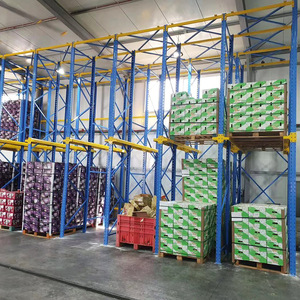
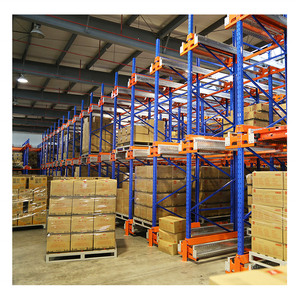
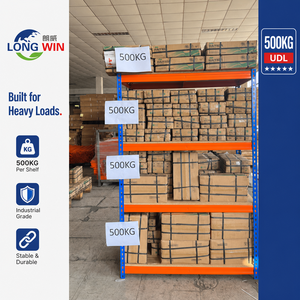
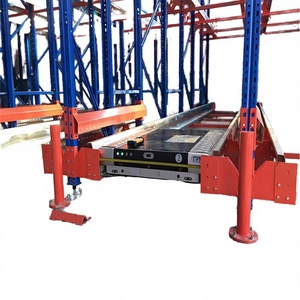
1. Technical Mechanics of Gravity Flow Pallet Racking (Pallet Flow)
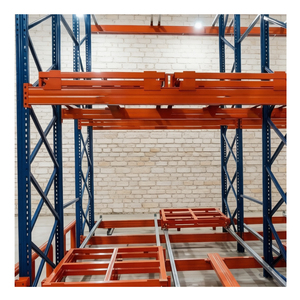
Gravity Flow Pallet Racking, also known in global logistics engineering as Pallet Flow Racking, operates on dynamic gravity-assisted kinetic principles. Unlike static selective racking systems, gravity flow rack structures utilize inclined roller beds mounted on structural steel beams at a predetermined gradient angle (typically between 3.5% and 4.5% or roughly 3/8-inch pitch per foot). Pallets are loaded from the higher charging end (loading face) and roll automatically down toward the lower discharging end (picking face) under controlled gravitational force.
This design creates a strict First-In, First-Out (FIFO) inventory management sequence. The physics governing safe pallet movement involves balancing gravitational acceleration against rolling friction, kinetic brake friction, and inertia. As leading China wholesale gravity flow pallet racking manufacturers, our engineering teams carefully calibrate track pitch based on pallet bottom runner geometry, unit payload mass, and ambient thermal conditions.
Key Engineering Rule: Pitch angle optimization is critical. Too steep an angle causes uncontrolled velocity and terminal impact forces; too shallow an angle risks pallet hanging (stopping midway in deep-lane runs).
Core Sub-Systems of Industrial Gravity Flow Racking
- Structural Steel Support Frame: Heavy-duty cold-rolled or structural I-beam uprights (Q235B / Q355B grade steel) designed to absorb dynamic braking forces and high static loads up to 2,500 kg per pallet position.
- Precision Roller Tracks: Available in full-width steel rollers or modular triple-track skate wheel layouts. Precision ball bearings ensure smooth coefficient of friction ($\mu \approx 0.025 - 0.04$).
- Magnetic & Centrifugal Speed Controllers (Brake Rollers): Mounted at precise intervals (every 1 to 2 pallet depths) within the track bed. Internal centrifugal or magnetic brake mechanisms govern terminal pallet velocity to a safe speed under $0.3 \text{ m/s}$.
- Pneumatic & Mechanical Pallet Separators: Positioned at the discharge end. These mechanisms isolate the first pallet from the back pressure of trailing pallets (which can exert thousands of kilograms of cumulative force), allowing unhindered forklift extraction.
- Ramp Stops & Impact Entry Guides: Heavy-gauge steel stops at the lane exit retain the pallet securely, while funnel-shaped entry guides at the loading face prevent improper pallet entry alignment.
High-Density Warehouse System Architectural Comparison
Evaluate structural, operational, and financial metrics across core dynamic storage topologies.
| Storage System Topology | Rotation Principle | Volumetric Density Utilization | Forklift Aisle Requirement | Operator Risk Factor | Ideal Industry Application |
|---|---|---|---|---|---|
| Gravity Pallet Flow Racking | Strict FIFO | Up to 85% | 2 Aisles (Load & Pick) | Low (No forklift rack entry) | Food & Beverage, Cold Chain, Pharma |
| Push Back Racking | Strict LIFO | Up to 75% | 1 Aisle (Front Load/Pick) | Low (Nested cart loading) | Medium-turn SKU buffers, Grocery |
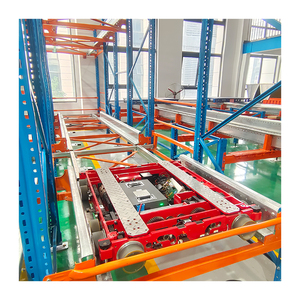
| Radio Shuttle Racking | FIFO / LIFO (Configurable) | Up to 90% | 1 or 2 Aisles | Very Low (Automated shuttle) | Bulk distribution, Frozen goods |
| Drive-In Racking | LIFO | Up to 65% | 1 Main Access Aisle | High (Forklift drives inside bays) | Homogeneous bulk raw materials |
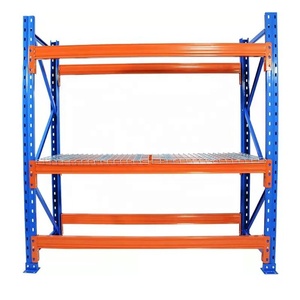
| Selective Pallet Racking | 100% Selectivity | 35% - 40% | Multiple Operational Aisles | Moderate (Standard loading) | E-commerce fulfillment, High-SKU hubs |
2. Technology & Development Trends in Gravity Flow Racking
The global warehousing and logistics ecosystem is undergoing a dramatic shift toward high-density automation, driven by skyrocketing industrial real estate costs and labor shortages. Gravity flow pallet racking has evolved from simple passive mechanical beds into sophisticated hybrid automated storage components.
A. Smart Kinetic Braking & IoT Sensor Integration
Modern gravity flow factories in China are embedding contactless magnetic eddy-current brake rollers. Unlike traditional friction-pad brake rollers that wear down over time, eddy-current systems produce braking torque proportional to pallet speed without mechanical contact, eliminating wear and tear. Furthermore, IoT sensors integrated into the gravity lanes monitor lane occupancy, motion velocity, and temperature, transmitting real-time stock telemetry directly to Warehouse Management Systems (WMS).
B. Cold-Chain Optimization (-30°C Cryogenic Environments)
Cold storage facilities incur high energy costs per cubic meter. Gravity flow racking allows dense storage blocks with minimal aisle space. Advanced manufacturing developments include specialized synthetic low-temperature lubricants, stainless steel precision bearings, and polymer roller sleeves capable of operating continuously at -30°C without plastic embrittlement or moisture freeze-ups.
C. Integration with AGVs & Autonomous Mobile Robots (AMRs)
The rise of automated material handling requires hyper-precise rack manufacturing tolerances. Leading factories now manufacture gravity flow tracks featuring laser-guided entry funnels and automated mechanical release latches that interface seamlessly with AGVs and AMRs, ensuring perfectly centered pickup and drop-off without human intervention.
Eddy-Current Magnetic Brakes
Contactless speed control technology that automatically adjusts braking force dynamically according to pallet mass without friction wear.
Automatic Load Separators
Mechanical safety latches isolate the front pallet from trailing line pressure, enabling 100% safe forklift extraction without binding.
Ultra-High-Molecular HDPE
High-impact, wear-resistant roller sleeves engineered to handle wood, plastic, or metal pallet runners under heavy 2500kg loads.
3. Future Procurement Trends for Global B2B Storage Buyers (2025–2030)
Procurement directors and supply chain engineers evaluating China wholesale gravity flow pallet racking factories must navigate changing international compliance frameworks, steel grade volatility, and total cost of ownership (TCO) matrices. Key procurement trends shaping the market include:
1. Shift from Capital Expenditure (CAPEX) to Lifetime TCO Valuation
B2B buyers are moving away from selecting vendor quotes based purely on initial purchase price. In dynamic systems like gravity flow, low-quality roller bearings or sub-standard steel beam deflection rates lead to operational downtime, stuck pallets, and safety hazards. Procurement evaluation now prioritizes life-cycle endurance testing (e.g., 50,000 continuous pallet cycle validations) and multi-year warranties.
2. Customization of Profile Geometries & Hybrid Racking Systems
Modern distribution centers rarely employ standard, off-the-shelf racking dimensions. Procurement demands OEM and ODM capabilities where factories roll-form custom upright profiles (such as 90mm, 100mm, 120mm face widths) with variable steel thicknesses (1.8mm to 3.0mm). Hybrid system integration—combining gravity flow lower levels for fast picking with selective racking upper levels for reserve stock—has become a standard requirement.
3. Rigorous International Structural Certification Compliance
Global logistics hubs require compliance with localized structural and seismic design codes. Wholesale suppliers must provide comprehensive structural engineering calculation packages under EN 15512 (European Racking Code), RMI (Rack Manufacturers Institute USA standard), and FEM 10.2.02 guidelines. Structural validation through finite element analysis (FEA) is now mandatory for high-bay installations.
4. Sustainability & Green Steel Manufacturing Protocols
Corporate sustainability mandates require supply chains to report embodied carbon footprints. Leading China factories are adopting eco-friendly production methods, including closed-loop electrostatic epoxy powder coating lines, heavy-metal-free passivation treatments, and sourcing raw steel coils certified under ISO 14001 environmental management protocols.
4. Enterprise Advantages: Remprack Storage Solutions
Remprack Storage Solutions Co., Ltd. is a global manufacturer of heavy-duty industrial storage equipment, headquartered in Nanjing, China. Founded in 2006, Remprack has spent over two decades engineering and manufacturing high-density pallet racking systems, automated storage and retrieval systems (ASRS), mezzanine platforms, and specialty gravity flow systems.
40,000 m² Manufacturing Base
Equipped with fully automated continuous roll-forming lines, robotic welding stations, and automated powder coating systems.
Global Export Footprint
Over 2,000 completed major logistics projects delivered across 85+ countries in Europe, Americas, Middle East, and Asia-Pacific.
Stringent Certifications
Fully certified under CE, ISO 9001 (Quality Management), ISO 14001 (Environmental), and TUV Rheinland structural safety standard.
Technical OEM/ODM Capability & Quality Control Matrix
Remprack operates an end-to-end quality assurance system. Raw steel coils (Q235B and Q355B high-tensile steel) undergo rigorous yield stress testing upon arrival. Roll-formed components undergo automated optical dimensional inspection to ensure cross-sectional geometry alignment. All welded sub-assemblies (such as beam connector hooks and gravity bed frames) undergo ultrasonic weld flaw testing and powder coating thickness testing (minimum 60–80 microns) to ensure superior scratch and corrosion resistance.
We provide full structural layout calculations, CAD 2D spatial drawings, 3D BIM models, load signs, and comprehensive installation manuals for turnkey project deployment. Every system manufactured by Remprack carries a 10-year structural warranty.
5. Frequently Asked Questions (FAQ) for Gravity Flow Procurement
Optimize Your Warehouse Density with Custom Engineering
Consult with our engineering team today to receive a CAD layout proposal, structural load calculations, and factory-direct wholesale pricing within 24 hours.
Get a Quote