The Paradigm Shift in Automated Pallet Handling Systems (2025–2030)
An exhaustive guide to selecting, integration architectures, and operational optimization for enterprise logistics leaders, warehouse engineers, and global procurement directors.
1. Executive Summary: The Automation Imperative in Global Supply Chains
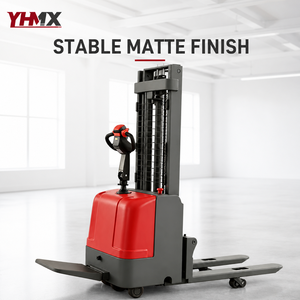
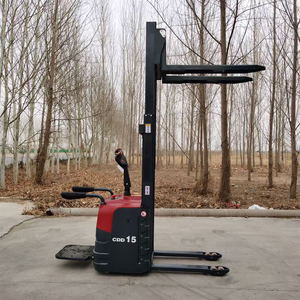
Modern material handling is undergoing a profound structural evolution. Volatile labor markets, rapidly escalating industrial real estate costs, and demanding omni-channel delivery SLAs have rendered manual pallet movement obsolete for high-throughput distribution facilities. Automated Pallet Handling Systems (APHS)—encompassing Autonomous Mobile Robots (AMRs), Automated Guided Vehicles (AGVs), Robotic Palletizing Cells, 4-Way Radio Shuttles, and Automated Storage and Retrieval Systems (ASRS)—now form the backbone of modern intra-logistics.
Chinese OEM and ODM factories have emerged as global leaders in this sector, leveraging dense component supply chains, extensive robotics R&D, and structural steel manufacturing scale. By delivering high-reliability hardware paired with open-API Warehouse Control Systems (WCS), Chinese exporters enable international buyers to achieve lower Total Cost of Ownership (TCO) and rapid Return on Investment (ROI).
Robotic Autonomy & Swarm Intelligence
High-Bay Density Maximization
Seamless IT/OT Convergence
2. Key Technological Trends Shaping Automated Pallet Handling
To establish a sustainable competitive advantage, procurement officers and operations directors must understand the structural trends driving equipment performance and system longevity:
A. Advanced Navigation: LiDAR SLAM vs. Visual SLAM
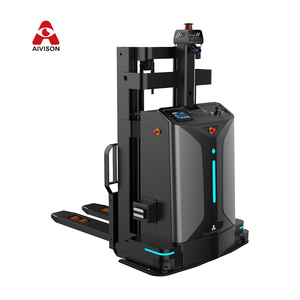
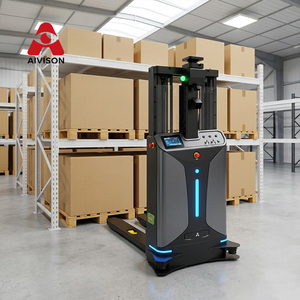
Legacy AGVs relied on floor-embedded magnetic strips or optical lines, restricting warehouse flexiblity. Modern Chinese AGV/AMR pallet movers utilize hybrid navigation frameworks combining 2D/3D LiDAR SLAM with Visual SLAM (vSLAM). This allows autonomous vehicles to map complex 50,000 m² warehouse environments in hours, dynamically re-route around temporary obstacles, and maintain sub-5mm positioning accuracy at pallet drop-off stations.
B. Heavy-Payload Robotic Palletizing & Collaborative Automation
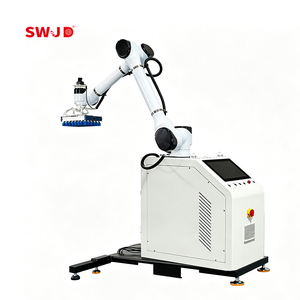
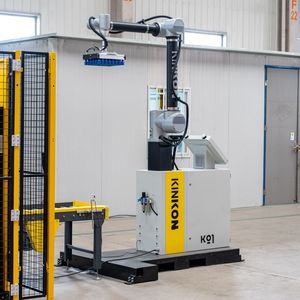
End-of-line packaging has moved beyond rigid, single-SKU mechanical stackers. Industrial 4-axis and 6-axis palletizing robots (such as the M50 series) feature adaptive end-of-arm tooling (EOAT) capable of lifting vacuum-sensitive cartons, heavy drums, or irregular bags up to 50kg per cycle at speeds exceeding 1,200 cycles per hour. Simultaneously, collaborative palletizing arms (Cobots) are eliminating safety cages, deploying force-torque sensors to work side-by-side with operators in tight production cells.
C. Energy Storage Evolution: Lithium Iron Phosphate (LiFePO4) & Opportunity Charging
Lead-acid batteries are rapidly being phased out. Chinese automated pallet movers incorporate high-density LiFePO4 battery chemistries paired with automated fast-charging pads. Systems can charge during 5-minute operational pauses, sustaining 24/7 multi-shift operations without battery swapping or dedicated charging rooms.
When deploying high-point-load equipment like 2-ton AMR forklifts or 15-meter ASRS shuttle racks, floor levelness must conform to DIN 18202 or FM2/Superflat specifications. Structural slab load capacity must be engineered to withstand static loads exceeding 100 kN/m² and localized dynamic braking forces.
3. Global Sourcing Trends: Why Enterprise Buyers Partner with Chinese Exporters
Sourcing automated material handling equipment internationally requires evaluating technical execution, structural engineering rigor, compliance, and long-term support. Chinese automated pallet system suppliers have established clear advantages in key operational dimensions:
- End-to-End Vertical Integration: Leading factories like Remprack manufacture both the physical heavy-duty racking infrastructure and integrate the electronic automation layer, eliminating interface mismatches between rack tolerances and shuttle mechanics.
- Standardized Regulatory Compliance: Top-tier Chinese exporters build directly to European CE standards (Machinery Directive 2006/42/EC, EN ISO 3691-4 for driverless industrial trucks) and American RMI/ANSI specifications.
- Modular OEM/ODM Customization: Factory-direct customization allows international systems integrators to specify customized colorways, custom fork dimensions, cold-storage low-temperature packages (down to -30°C), and specific PLC brands (Siemens, Schneider, Omron).
4. Comparative Selection Framework for Automated Systems
Selecting the optimal automated pallet handling technology depends on SKU diversity, throughput requirements, building height, and capital budget. The matrix below outlines primary engineering selection parameters:
| Handling Technology | Pallet Density | Selectivity | Throughput Rate | Optimal Application Scenario |
|---|---|---|---|---|
| Forklift AMR / AGV | Medium | 100% (Direct Access) | Moderate (30-60 pallets/hr) | Cross-docking, plant-to-warehouse transport, floor staging |
| 4-Way Radio Shuttle | Ultra-High | Channel Level (FIFO/LIFO) | High (60-120 pallets/hr) | Deep-lane high-density cold storage & bulk FMCG storage |
| Robotic Palletizer (M50) | N/A (End-of-Line) | Single/Dual Line | Very High (800-1500 units/hr) | Manufacturing plant outfeed, packaging line automation |
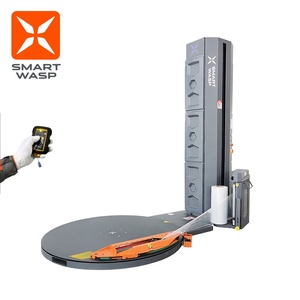
| Automated Stretch Wrapper | N/A (Packaging) | In-line / Standalone | High (40-80 pallets/hr) | Pallet stabilization prior to high-bay automated racking storage |
| ASRS Stacker Crane | Very High | 100% Automated | Extreme (150+ pallets/hr) | High-bay warehouses (>20m height), fully automated distribution |
5. Enterprise Advantages & Quality Assurance Protocols at Remprack
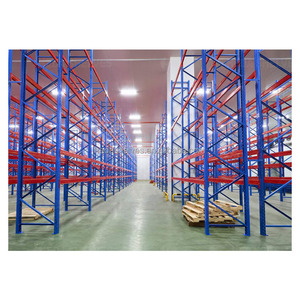
At Remprack Storage Solutions, automated pallet handling is approached as a structural and mechanical ecosystem. Racking systems are engineered with tight tolerances to prevent guide rail deflection, ensuring smooth radio shuttle travel and error-free AMR fork positioning.
Our manufacturing workflow utilizes prime structural steel (Q235B and Q355B grades) subjected to continuous structural stress testing. Ultrasonic weld inspections, powder coating thickness checks (80–100 microns standard), and full pre-shipment assembly trials ensure that components integrate seamlessly upon arrival at client sites worldwide.