High-Density LIFO Racking Architecture: Industrial Engineering & Structural Mechanics
An authoritative engineering whitepaper on Last-In, First-Out (LIFO) pallet storage dynamics, mechanical payload optimization, EN 15512 structural compliance, and global procurement strategies.
In modern industrial warehousing and automated material handling, maximizing volumetric cube utilization while controlling capital expenditure (CAPEX) represents the core engineering objective for supply chain directors. Last-In, First-Out (LIFO) pallet racking systems serve as the gold standard for high-density pallet storage where high throughput and SKU consolidation take precedence over individual pallet selectivity. Manufactured under strict European Standard EN 15512 and certified with European Conformity (CE mark), LIFO racking structures engineered by Remprack Storage Solutions Co., Ltd. offer an unmatched combination of structural safety factors, dynamic load tolerance, and operational efficiency.
LIFO warehouse racking operates on the foundational principle where the final pallet loaded into a dedicated storage lane is the primary unit retrieved during outbound fulfillment. This engineering topology eliminates the need for multiple fork truck operating aisles, converting up to 75% of wasted aisle floor space into high-density storage positions. The primary structural configurations of LIFO racking engineered at our Nanjing manufacturing facility include Push-Back Cart Systems, Inclined Gravity Push-Back Roller Systems, Heavy-Duty Drive-In/Drive-Thru Racks, and semi-automated Radio Shuttle LIFO Platforms.
Featured CE Certified LIFO & Heavy-Duty Racking Systems
Direct factory-engineered storage hardware tailored for heavy industrial loads, cold storage facilities, and high-bay distribution hubs.
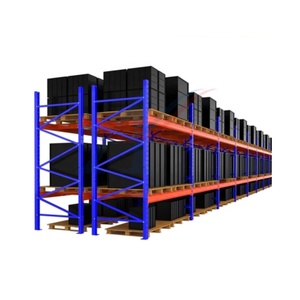
Customized Warehouse Storage Steel Heavy Duty Pallet Rack System with 15000kg Capacity 2 Layers Powder Coated
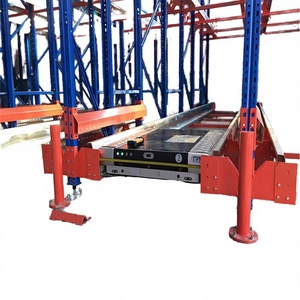
Heavy Duty Rack System Warehouse Storage Radio Shuttle Pallet Racking Semi Automated Storage Solution
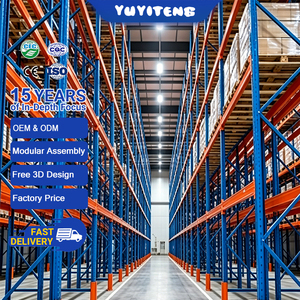
Drive in Pallet Rack High Density Storage System OEM Customized From Professional Factory
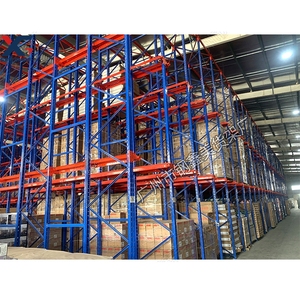
Boltless Metal Steel Stacked Parking System Refrigerated Warehouse Drive-in Rack Double Pallet Rack System
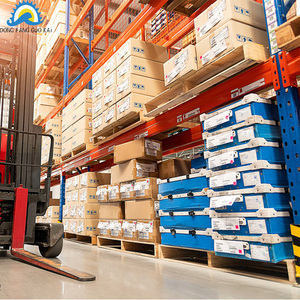
Double Deep Heavy Duty Steel Pallet Rack 6 Meters High Boltless Corrosion Protection Adjustable Layers Warehouse Shelving
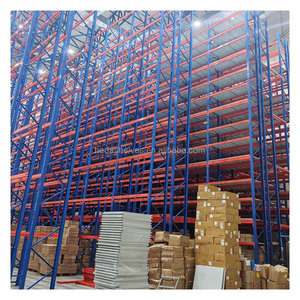
China Factory Price Steel Selective Heavy Duty Storage Racking Industrial Rack Shelving Pallet Rack Manufacturers
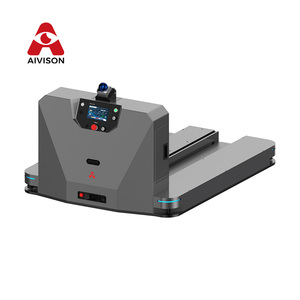
China AGV Manufacturer Automated AMR Open Pallet / Closed Pallet Handling Robot For Warehouse Logistics
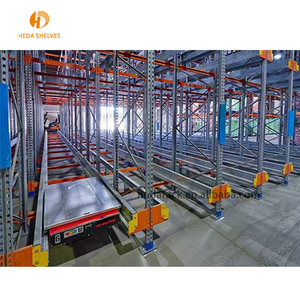
OEM High-Tech Radio Shuttle Pallet Rack Industrial Steel Automatic Warehouse Racking System For Storage
Kinetic Principles & Mechanical Load Calculations of LIFO Systems
Designing a structural LIFO rack requires a deep understanding of static structural loads, dynamic impact allowances, and kinetic friction coefficients. In Push-Back LIFO Racking Systems, nested carts travel along inclined structural steel rails set at a slope angle ($\theta$) typically ranging between $1.5^\circ$ and $3.0^\circ$.
When a lift truck pushes the incoming pallet into the storage bay, it overcomes the gravitational force component of the existing stored pallets and the rolling friction coefficient ($\mu_r$) of the heavy-duty steel wheels riding on the guide track. The total required pushing force ($F_p$) exerted by the forklift mast can be mathematically modeled using the formula:
Where $m_i$ is the mass of each individual pallet (up to 1500kg), $g$ is the gravitational acceleration ($9.81 \, m/s^2$), $\theta$ is the rail slope, $\mu_r$ is the mechanical wheel friction coefficient ($\approx 0.005$ to $0.015$ for sealed ball bearing steel rollers), and $F_{dynamic}$ accounts for the initial kinetic resistance during placement. Remprack engineers precisely roll-form the nesting cart channel tracks from high-tensile Q355B cold-rolled structural steel to guarantee smooth cart flow without jam-ups or dangerous pallet surges during retrieval operations.
Comprehensive LIFO vs. Alternative Storage Architecture Matrix
| Racking Architecture | Stock Rotation Method | Volumetric Space Utilization | SKU Selectivity % | Pallet Lane Depth Capacity | Ideal Industrial Application |
|---|---|---|---|---|---|
| Push-Back Cart System | LIFO (Last-In, First-Out) | 75% - 80% | 20% - 35% | 2 to 6 Pallets Deep | Cold Storage, Food & Beverage, 3PL Distribution |
| Drive-In Racking | LIFO (Last-In, First-Out) | 65% - 75% | 10% - 15% | 5 to 10+ Pallets Deep | Homogeneous High-Volume Batch Goods |
| Radio Shuttle LIFO System | Software Configurable (LIFO / FIFO) | 85% - 90% | 15% - 25% | 20 to 50+ Pallets Deep | Automated Logistics Hubs, FMCG Warehousing |
| Selective Pallet Racking | FIFO (First-In, First-Out) | 35% - 45% | 100% Selectivity | 1 Pallet Deep | High-SKU E-Commerce Fulfillment, Spare Parts |
| Pallet Flow Gravity Racking | FIFO (First-In, First-Out) | 70% - 80% | 20% - 30% | 2 to 20 Pallets Deep | Perishable Goods, Pharmaceutical Warehousing |
Future Procurement Trends & Evolution of Industrial Racking Technology
How Industry 4.0 automation, AGV integration, sustainability requirements, and advanced material science are transforming high-density pallet storage.
1. Automated Guided Vehicle (AGV/AMR) Integration
Traditional LIFO push-back and shuttle systems are rapidly adapting to interface seamlessly with Autonomous Mobile Robots (AMRs) and AGVs. Custom target plates, optical alignment sensors, and high-precision laser-guided rack entry beams ensure zero human error during automatic loading.
2. Hybrid 4-Way Radio Shuttle & Intelligent WMS
The boundary between static LIFO storage and automated storage/retrieval systems (ASRS) is blurring. Next-generation radio shuttles feature 4-directional travel capabilities, dynamic weight sensor diagnostics, and direct cloud integration with Warehouse Management Systems (WMS).
3. Ultra-Low Temperature Cold Chain Optimization
Energy prices in cold chain logistics demand maximum volumetric efficiency. Modern LIFO systems engineered for cold rooms operate continuously at temperatures down to -30°C utilizing specialized anti-brittle low-carbon structural steel and low-viscosity synthetic lubricants.
4. Advanced Micro-Alloy Steel & Sustainable Powder Coatings
Steel manufacturing innovation allows thinner, lighter, yet structurally stronger upright profiles. Utilizing micro-alloyed structural steels like Q355B and Q420, combined with non-toxic, zero-VOC electrostatic epoxy powder coating processes, reduces environmental impact while extending anti-corrosion shelf life.
5. Seismic Resilience & Dynamic FEA Simulation
Global procurement guidelines now require mandatory Finite Element Analysis (FEA) modeling under dynamic seismic loads (such as Eurocode 8 or RMI standards). Real-time simulation of rack deflection ($L/200$) under full payload stress ensures structural stability during earthquake events.
6. Modular Expansion & Boltless Assembly
Logistics facilities require rapid scalability without operational shutdown. Modern LIFO systems utilize teardrop or beam-hook interlock geometry, allowing upright height adjustments in 50mm or 75mm increments without torching or field welding.
Why Global Procurement Directors Choose Remprack Storage Solutions
Established in 2006 in Nanjing, China, Remprack Storage Solutions Co., Ltd. has grown into a premiere world-class manufacturer and exporter of certified industrial pallet racking systems. Operating a state-of-the-art 40,000 m² automated production base staffed by over 300 skilled technicians, engineers, and supply chain experts, Remprack provides full-lifecycle storage solutions from structural design to overseas installation.
- ✓ CE, ISO 9001, ISO 14001 & TUV Rheinland Certified: Every batch of steel profiles undergoes rigorous tensile strength testing, chemical composition analysis, and weld integrity inspection.
- ✓ Proven Export Record Across 85+ Countries: Over 2,000 large-scale warehouse projects executed across Europe, North America, South America, Southeast Asia, the Middle East, and Africa.
- ✓ Comprehensive 10-Year Factory Warranty: We guarantee structural integrity, beam deflection tolerances, and powder coating durability under standard operational conditions.
- ✓ Full OEM & ODM Fabrication Capabilities: Custom upright profile punchings, custom brand colors (RAL color matching), client logo silk-screening, and bespoke beam connector configurations.
- ✓ Automated Production Lines: Continuous automated cold-roll forming machines, robotic welding cells, and automated electrostatic powder coating lines ensure minimal manufacturing variance.
- ✓ Free Engineering CAD & 3D Layout Proposals: Rapid turnaround on structural designs, layout optimization, payload distribution calculations, and technical submittals within 24 hours.
Industrial Procurement & Structural Engineering FAQ
Expert technical answers addressing floor loading limits, compliance standards, cold storage adaptation, and procurement logistics.
What warehouse parameters are mandatory to engineer a CE-certified LIFO pallet racking layout?
- Architectural Floor Plan: Architectural drawings (CAD or PDF format) showing clear building dimensions, column grid centers, building eaves height, clear height under sprinklers/lighting, and location of warehouse doors.
- Pallet Data & Unit Loads: Length, width, overall height (including pallet footprint), and maximum gross load weight per pallet (e.g., 1000kg, 1200kg, 1500kg).
- Forklift Specifications: Forklift type (Reach truck, Counterbalance, VNA), maximum lift height, collapsed mast height, turning radius ($A_{st}$), and load capacity curve.
- Environmental Conditions: Operating temperatures (ambient room vs -25°C freezing room), local seismic zone acceleration factor ($S_a$), and floor slab thickness/concrete compressive strength ($f'_c$).
How does a Push-Back Cart System differ mechanically from a Drive-In Racking System?
Push-Back Racking: Forklifts operate only in the front aisle without entering the rack structure. Pallets are loaded onto nested steel carts sliding on inclined tracks. Loading pallet #2 pushes cart #1 back into the lane. When picking, gravity moves the remaining pallets forward to the pick face. This provides faster access, higher safety, and zero structural upright damage from forklifts.
Drive-In Racking: Forklifts must physically drive inside the racking bays to place pallets onto continuous support arms. This configuration achieves slightly higher density for low-SKU bulk products, but requires skilled forklift drivers, increased loading cycle times, and higher risk of accidental upright impact, necessitating heavy-duty steel column protectors and floor guide rails.
What certifications and structural engineering standards do Remprack racking systems comply with?
- EN 15512:2020: European Standard for steel static storage systems – Adjustable pallet racking systems – Principles for structural design.
- FEM 10.2.02: Federation Europeenne de la Manutention standard for design of static steel pallet racking.
- CE Certification: Compliance with European Union Safety, Health, and Environmental Protection requirements (Machinery Directive for automated shuttle systems).
- ISO 9001 & ISO 14001: Internationally recognized Quality Management and Environmental Management system certifications covering raw material procurement through export shipping.
- RMI (Rack Manufacturers Institute): Specification for the design, testing, and utilization of industrial steel storage racks for North American projects.
What anti-corrosion surface treatments are available for humid or cold storage applications?
1. Electrostatic Epoxy Powder Coating: Standard for ambient indoor warehouses. Components undergo a multi-stage pre-treatment wash (degreasing, phosphating, deionized water rinse) followed by electrostatic powder deposition and high-temperature oven baking at 200°C. Total dry film thickness (DFT) is maintained between 80 to 110 microns, passing the 500-hour ISO 9227 salt spray test.
2. Hot-Dip Galvanizing (HDG): Recommended for outdoor storage yards, high-humidity processing plants, or corrosive chemical environments. The steel components are fully immersed in molten zinc at 450°C according to ISO 1461, forming a thick zinc-iron alloy protective layer (60 to 100 microns) that offers 30+ years of maintenance-free corrosion resistance.
What is the typical lead time, export packaging, and installation support for overseas orders?
We provide comprehensive installation manuals, 3D assembly diagrams, bolt torque specifications, and offer remote video guidance or on-site installation engineers upon request.
Can Remprack manufacture customized profiles and OEM branded racking components for distributors?
Optimize Your Warehouse Storage Density Today
Connect directly with Remprack's structural engineering team for a free CAD layout design, static payload load analysis, and an immediate factory-direct pricing proposal.