Choosing China’s top Standard Pallet Racking manufacturers requires more than comparing prices or polished factory photographs. A reliable supplier must demonstrate engineering competence, consistent production, tested materials, and practical installation experience. This article examines manufacturers through those measurable factors, rather than relying on promotional claims alone.
Gwynne Richards, author of Warehouse Management, has observed that “a warehouse is not just a storage space; it is a critical part of the supply chain.” His point matters when evaluating pallet rack suppliers. A strong manufacturer should understand load capacity, beam deflection, forklift clearance, seismic conditions, and warehouse workflow. It should also provide clear drawings, inspection records, and traceable steel specifications. Small details matter. A bent upright can affect an entire storage aisle.
The following overview considers respected Chinese manufacturers of Standard Pallet Racking, including their production capabilities, customization services, quality systems, export experience, and after-sales support. It also explains how buyers can compare suppliers fairly. Certifications deserve verification, not blind acceptance. Factory audits can reveal more than a website. So can references from warehouses using similar loads.
No ranking is permanent. Market performance changes. Some manufacturers may excel in heavy-duty systems, while others perform better in automated or high-density projects. That distinction is easy to miss. Buyers should confirm current certifications, sample quality, delivery records, and engineering responsibility before signing a contract. This approach may take longer, but it reduces expensive surprises after installation.
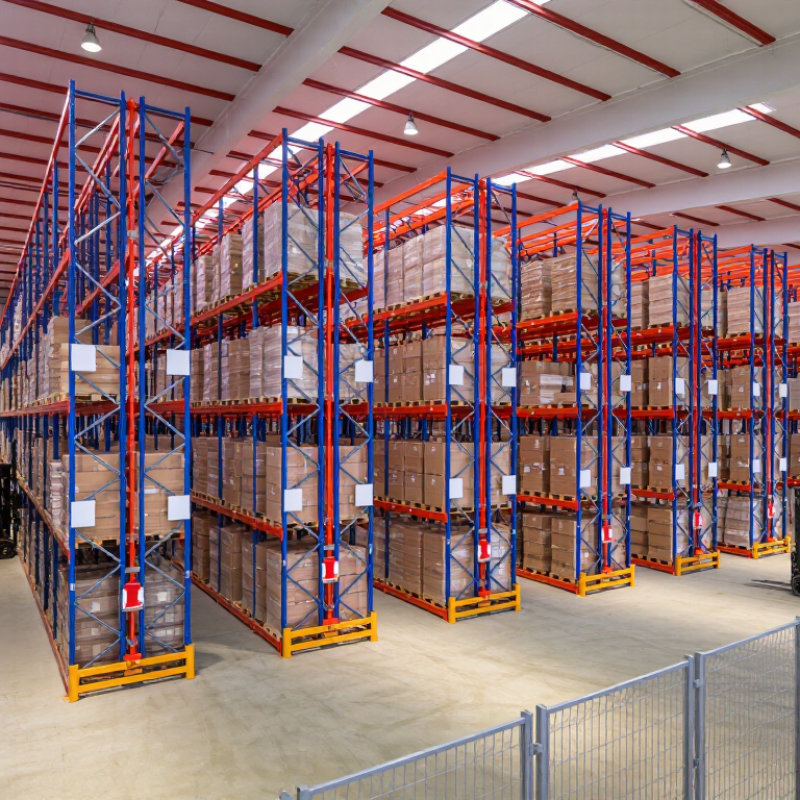
A top standard pallet racking manufacturer in China begins with engineering discipline, not attractive brochures. China’s National Bureau of Statistics reported that the country’s total social logistics value reached 360.6 trillion yuan in 2024, rising 5.8% year on year. This scale demands stable storage systems, accurate production, and dependable after-sales support. Manufacturers should provide load calculations for every beam level, upright profile, and floor condition. Clear drawings matter. So does traceable steel.
Professional capability also appears in testing and standards. A reliable factory can explain its compliance with ISO 9001 and relevant European racking guidance, including EN 15512 where applicable. Independent testing should verify beam deflection, connection strength, coating thickness, and impact resistance. The China Federation of Logistics and Purchasing reported continued expansion in China’s logistics activity during 2024. Yet growth alone does not prove quality. Buyers still need factory audits, sample inspections, and installation records.
Practical experience separates strong manufacturers from ordinary exporters. A good supplier studies forklift turning radius, pallet dimensions, sprinkler clearance, and seismic conditions before quoting. It should offer replacement-part identification years after delivery. That detail is easy to overlook. MHI’s 2024 Annual Industry Report highlights rising investment in supply-chain technology and automation, but automated equipment cannot correct weak rack design. No checklist is perfect. Some suppliers still publish static load figures without explaining testing conditions. That deserves scrutiny. The better question is not only, “How low is the price?” It is, “Can this system remain safe, measurable, and serviceable after years of daily impact?”
Standard pallet racking provides direct access to stored pallets. Leading Chinese manufacturers are often evaluated by engineering control, steel quality, and production consistency. A reliable supplier should offer load calculations, assembly drawings, and traceable material records. It should also adapt designs to local building and fire requirements.
Selective pallet racking is the most common type. It suits warehouses needing access to every pallet. Drive-in racking increases density but reduces product selectivity. Push-back systems store pallets by depth and support faster loading cycles. Double-deep layouts improve space use, although they require suitable handling equipment. Small details matter.
Typical specifications include frame height, frame depth, beam length, and rated load. Upright frames often use roll-formed steel with reinforced columns. Beam capacity depends on span, pallet weight, and shelf levels. Clearances should allow safe forklift movement and pallet placement. A common mistake is choosing capacity from a catalog without checking real load distribution.
Practical evaluation should include floor conditions, aisle width, pallet dimensions, and impact protection. Ask for coating thickness, weld inspection records, and installation guidance. Designs may reference EN, FEM, RMI, or applicable local standards. Still, a certificate alone cannot replace a site review. One overlooked measurement can disrupt an entire aisle. Recheck the layout.
China’s top standard pallet racking manufacturers usually specialize in selective, drive-in, double-deep, and cantilever systems. Their product strengths differ by factory scale and engineering focus. Large manufacturers often provide automated storage interfaces, seismic calculations, and complete warehouse layouts. Mid-sized producers may offer faster customization and competitive pricing for regional distribution centers.
A reliable manufacturer should show tested load data, clear steel specifications, and traceable welding procedures. Look for upright frames with consistent hole spacing, reinforced base plates, and beams with secure locking pins. Powder-coated surfaces should resist scratches from forklifts and daily handling. Some factories maintain automated roll-forming lines, while others depend more heavily on manual fabrication. This difference can affect dimensional consistency. No supplier is perfect. Independent inspection still matters.
Tips: Ask for a sample bay, not only catalog images. Confirm the rated load per level and frame. Request installation drawings and maintenance guidance. Check whether replacement beams, pins, and protectors remain available. Measure your pallet dimensions carefully; a small clearance error can reduce usable capacity. Also review delivery records for similar warehouse sizes. Price alone can mislead. A cheaper rack may require stronger floor preparation, extra protectors, or later modifications. In practice, the best choice balances engineering support, manufacturing control, delivery reliability, and after-sales responsiveness.
| Manufacturer Segment | Primary Product Strength | Typical Racking Systems | Common Material and Finish | Typical Load Range* | Relevant Standards and Design Practice | Best-Fit Applications |
|---|---|---|---|---|---|---|
| Heavy-Duty Selective Racking Manufacturers | Flexible storage with direct access to every pallet position | Adjustable pallet racking, double-deep racking, narrow-aisle racking | Cold-rolled or hot-rolled structural steel; powder coating or galvanized components | Approximately 500–5,000 kg per pallet position, subject to beam span and engineering calculations | EN 15512, EN 15629, EN 15635, FEM guidance, or ANSI/RMI requirements where applicable | General warehouses, distribution centers, spare-parts storage, and mixed-SKU inventory |
| Drive-In and Drive-Through Racking Manufacturers | High-density storage with reduced aisle requirements | Drive-in racks, drive-through racks, block-storage systems | High-strength structural steel rails, frames, guide rails, and pallet support rails | Often designed for multiple pallets per lane; capacity depends on lane depth, pallet type, and forklift loads | Engineered to applicable steel-storage-rack standards and forklift operating clearances | Cold stores, beverage warehouses, food distribution, and products with limited SKU variety |
| Heavy-Load Shuttle Racking Manufacturers | High-density storage combined with reduced forklift travel inside rack lanes | Radio-shuttle racks, semi-automated pallet shuttle systems | Reinforced steel frames, shuttle rails, pallet stops, sensors, and control components | Commonly engineered for approximately 1,000–2,000 kg per pallet, with project-specific verification | Rack design follows applicable storage-rack standards; shuttle equipment requires electrical and control-system validation | High-volume warehouses, cold-chain operations, batch storage, and FIFO or LIFO workflows |
| Automated Storage and Retrieval System Manufacturers | Integration of storage racks with stacker cranes, conveyors, and warehouse software | AS/RS pallet racks, crane-based high-bay systems, automated buffer storage | Precision-fabricated steel structures with machine interfaces, sensors, rails, and safety guarding | Project-engineered capacities commonly range from about 500 kg to over 1,500 kg per pallet position | Rack standards combined with machinery safety, electrical safety, load-transfer, and software-integration requirements | High-throughput distribution, manufacturing logistics, e-commerce, and space-constrained facilities |
| Long-Span and Multi-Tier Racking Manufacturers | Efficient storage of cartons, components, and hand-loaded products | Long-span shelving, carton-flow racks, multi-tier platforms, mezzanine-supported shelving | Roll-formed steel beams, uprights, decking panels, stairways, handrails, and safety gates | Typically about 200–1,000 kg per shelf level, depending on span, decking, and support spacing | Designed according to structural steel, platform loading, guardrail, stair, and workplace-safety requirements | Parts warehouses, archives, retail backrooms, workshops, and small-item fulfillment areas |
| Mobile and High-Density Rack Manufacturers | Improved floor utilization by mounting rack rows on powered or mechanically assisted bases | Mobile pallet racking, mobile archive shelving, compact storage systems | Standard steel rack modules combined with floor rails, drive units, controls, and safety sensors | Capacity is based on the rack configuration and floor loading; pallet applications may exceed 1,000 kg per position | Requires rack engineering plus floor-load, drive-system, emergency-stop, access-control, and safety assessment | Cold storage, archives, museums, high-value inventory, and facilities where floor area is limited |
| Export-Oriented Custom Rack Manufacturers | Adaptation of rack dimensions, finishes, accessories, and documentation to overseas project requirements | Selective, drive-in, cantilever, flow, mezzanine, and customized warehouse systems | Cold-rolled or structural steel; painted, powder-coated, or hot-dip galvanized finishes | Determined by the approved design drawings, pallet dimensions, seismic conditions, and local regulations | May provide calculations, drawings, installation manuals, inspection documents, and compliance documentation for the destination market | International warehouse projects requiring customized dimensions, container loading, and export documentation |
*Load ranges are indicative industry ranges rather than guaranteed ratings. The final safe working load must be confirmed through project-specific structural calculations, pallet specifications, forklift loads, seismic conditions, floor capacity, and the applicable local standard.
China’s leading standard pallet racking manufacturers should prove more than production volume. They need controlled steel sourcing, documented welding procedures, and repeatable dimensional accuracy. The World Steel Association reported that China produced about 1,019 million tonnes of crude steel in 2023. This supply depth supports large-scale rack production, but raw material availability does not guarantee structural safety.
Look for ISO 9001 certification, traceable batch records, and inspection reports for uprights, beams, welds, and coatings. The ISO Survey 2023 recorded 1,265,216 ISO 9001 certificates worldwide, showing its broad acceptance as a quality-management framework.
Still, certification alone is not enough. Ask whether the factory tests beam deflection, connector strength, column compression, and seismic requirements. Real evidence matters more than a certificate on the wall.
Manufacturing capability should include automated roll forming, calibrated punching, robotic or controlled welding, and powder-coating checks. Independent testing against EN 15512, EN 15635, FEM guidance, or applicable GB/T standards can improve confidence. Factory acceptance testing should include sample loading and measurement records. Small defects matter. A one-millimeter hole mismatch can complicate installation across a long aisle. I would also review nonconformance records, because perfect factory claims deserve careful questioning. Data needs checking. Rack capacity depends on design, installation, floor conditions, and daily operating practices.
Choosing among China’s top standard pallet racking manufacturers requires more than comparing quoted prices. Start with the rack’s intended use: pallet weight, beam length, forklift type, aisle width, and warehouse height. A reliable manufacturer should request these details before preparing drawings. Vague quotations often hide weak assumptions.
Check the manufacturer’s engineering process and production controls. Ask for steel grades, load calculations, welding procedures, surface treatment details, and inspection records. Factory audits can reveal useful evidence, such as automated cutting equipment, coating thickness checks, and organized component storage. Request independent test reports when the project has seismic or high-load requirements. Also examine tolerance standards. Small dimensional errors can make installation frustrating.
Past project evidence matters. Ask for references from warehouses with similar pallet weights and operating conditions. Study photographs carefully; polished images prove little. A stronger supplier provides layout drawings, installation guidance, spare-part availability, and clear warranty terms. Confirm whether technical support operates in your time zone. Compare the complete cost, including packing, shipping, installation, and future replacement parts.
Do not choose only by the lowest offer. That approach can fail.
A practical shortlist may include three manufacturers. Send each the same technical specification and evaluation sheet. Compare response speed, drawing accuracy, material transparency, and willingness to correct mistakes. Some suppliers may promise more than their factory can consistently deliver. That deserves attention. A slower, detailed response may be more valuable than a fast quotation with missing data.
The chart presents a practical procurement weighting for comparing pallet racking manufacturers. Product quality and structural compliance should receive the highest priority, followed by load engineering, manufacturing capability, delivery reliability, customization, and total cost. Buyers should verify technical drawings, material certificates, load calculations, factory quality controls, and compliance with applicable standards such as EN 15512, FEM guidance, or relevant Chinese standards before selecting a supplier.
Strong manufacturers begin with engineering, not attractive brochures. They provide load calculations, clear drawings, and traceable steel records. Factory consistency matters.
Request frame height, frame depth, beam length, pallet weight, and rated capacity. Ask how capacity changes across different spans and shelf levels. Catalog figures alone can mislead.
Review welding records, coating thickness checks, beam deflection tests, and connection-strength reports. Factory audits can reveal production discipline. Certificates help, but they are not enough.
Selective racking usually suits warehouses needing access to every pallet. It supports flexible storage and straightforward stock handling. Aisle width still needs careful review.
Drive-in racking increases storage density but reduces product selectivity. Push-back systems support deeper storage and faster loading cycles. Handling equipment must match the design.
Designers should check pallet dimensions, floor strength, forklift turning radius, aisle width, ceiling height, and sprinkler clearance. Seismic conditions may also affect engineering. Measure twice.
Send each supplier the same technical specification and evaluation sheet. Compare drawing accuracy, material transparency, response quality, and correction speed. The cheapest offer may hide missing assumptions.
Confirm installation guidance, warranty terms, technical support, and spare-part identification. Replacement parts should remain traceable years later. This detail is easy to overlook.
Be cautious when a quotation lists static loads without testing conditions. Polished project photographs prove little. Vague drawings and missing tolerance data may create installation problems. Recheck everything.
China’s top Standard Pallet Racking manufacturers are defined by their ability to combine structural reliability, efficient production, engineering expertise, and consistent customer support. They typically offer a broad range of solutions, including selective pallet racking, drive-in systems, double-deep configurations, and adjustable designs for different warehouse layouts and load requirements. Strong manufacturers also provide accurate technical specifications, stable raw material quality, advanced fabrication processes, and strict inspection procedures to ensure safety, durability, and installation accuracy.
When comparing Chinese manufacturers, buyers should evaluate load capacity, product dimensions, surface treatment, customization capabilities, delivery performance, and after-sales service. Certifications, documented quality-control systems, testing procedures, and manufacturing capacity can help confirm whether a supplier meets professional warehouse standards. The right choice should balance product performance, total cost, lead time, communication efficiency, and long-term maintenance needs. A reliable manufacturer should be able to understand the warehouse’s operational requirements and provide a practical, scalable, and safe storage solution rather than simply offering the lowest price.
