Warehouse space is expensive, and every wasted aisle can reduce the number of usable pallet locations. Narrow Aisle Pallet Racking helps warehouses store more pallets within a given footprint, but tighter layouts also demand careful equipment and safety planning. The right system depends on more than rack dimensions.
The pressure is measurable. The U.S. Census Bureau reported that U.S. e-commerce sales reached $1.19 trillion in 2024, or 16.1% of total retail sales. That growth can mean faster order cycles, more frequent picking, and less room for inefficient travel paths. MHI’s 2024 Annual Industry Report, based on a survey of more than 1,000 supply chain professionals, also describes sustained investment in supply chain technology and innovation. These reports do not prescribe a rack layout, but they show why storage density and operating speed matter.
A narrower aisle is not automatically a better aisle. Reach trucks, turret trucks, and guided systems have different turning needs, lift heights, and operating costs. Rack height, pallet dimensions, floor condition, fire protection, and retrieval frequency also shape the decision. A few centimeters can matter when a loaded truck turns beside an upright. So can a clear view of the load.
This guide compares seven common systems, from selective narrow-aisle layouts to high-density options. It focuses on practical trade-offs, not just capacity claims. Some warehouses may gain little from going narrower; that deserves an honest look. The best choice is the one that fits the building and the daily work.
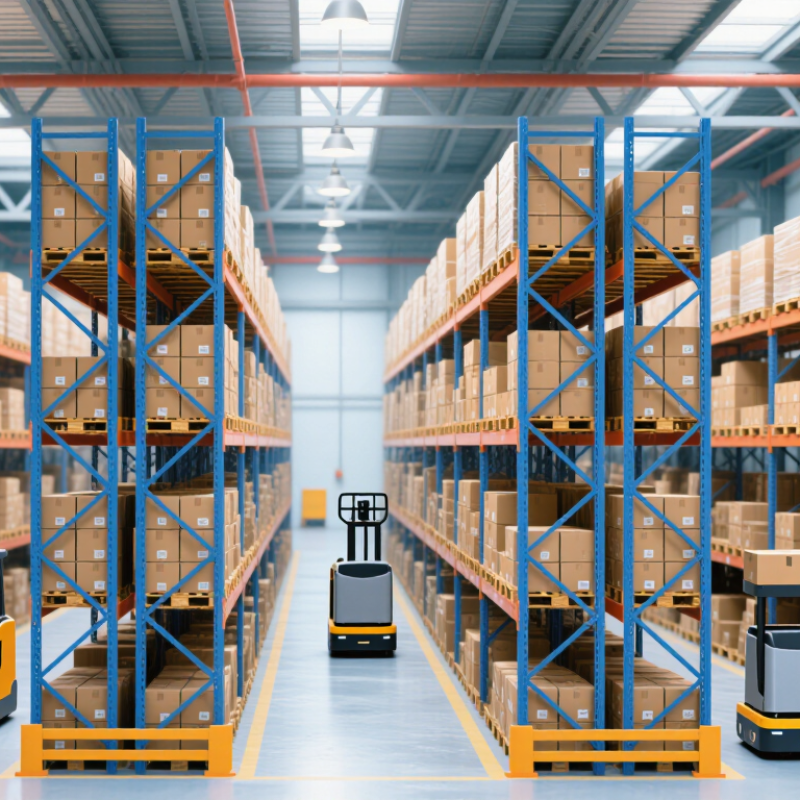
Narrow aisle pallet racking stores pallet loads in rows with less space between them than conventional layouts. A common aisle may be about 8 to 10 feet wide; very narrow aisle layouts can be around 5 to 7 feet. Actual dimensions depend on the lift truck, pallet size, load overhang, and building conditions. The rack itself does not move. Instead, reach trucks or turret trucks retrieve pallets from tighter aisles and lift them to higher beams. Some systems use guide rails or floor-based guidance to keep trucks aligned. The result is more rack positions within the same footprint, but not automatically faster picking.
The trade-off is real. On paper, the space gain looks clean; on a busy shift, one skewed pallet can slow a turn. MHI’s 2023 Annual Industry Report found that 74% of surveyed supply chain leaders planned to adopt or increase robotics and automation within five years. That trend makes narrow-aisle layouts worth evaluating alongside guided or automated equipment, not in isolation. Before installation, measure the largest load, check truck turning requirements, and test sightlines at working height. Aisle width should come from equipment specifications and operating trials, rather than a target number alone. Even careful plans miss something. Racks, trucks, and daily traffic must work together.
What narrow aisle pallet racking is and how it works
Narrow-aisle layouts use less floor space for aisles, leaving more room for storage. The chart shows indicative planning ranges; the aisle required depends on the handling equipment, pallet dimensions, load overhang, and site layout. Confirm clearances with your equipment and rack suppliers before design.
Comparing narrow-aisle pallet racking starts with the lift truck, not the rack drawing. Measure the minimum aisle width the truck can safely use, including turning and load-clearance space. A few inches matter. Check pallet dimensions, overhang, and load weight; uneven pallets can reduce clearance and make retrieval awkward. Compare rack height with ceiling clearance, sprinkler lines, lights, and building limits. A tall layout looks efficient on paper, but only if operators can place loads accurately.
Storage density is only one measure. Selective layouts provide direct access to each pallet, while denser systems may require deeper handling or guided equipment. Consider how often each SKU moves, whether first-in, first-out access matters, and how many picks occur during peak hours. A system that saves floor space may slow replenishment. That trade-off is easy to underestimate.
Review beam capacity, upright protection, anchoring, and floor condition with a qualified rack professional. Concrete joints, slopes, and damaged areas can affect installation and truck movement. Request load plaques and a clear inspection routine; bent components are not merely cosmetic. Compare installation downtime, operator training, maintenance access, and future reconfiguration costs. One detail often gets missed: test a full-size pallet along the planned route before finalizing the aisle plan. Real loads rarely behave as neatly as CAD blocks.
| System | Typical Operating Aisle | Access and Selectivity | Stock Rotation | Storage Density | Best Suited For | Key Trade-Off |
|---|---|---|---|---|---|---|
| Very Narrow Aisle (VNA) Selective Racking | About 5–7 ft (1.5–2.1 m); aisle width depends on truck and load dimensions. | Direct access to every pallet location; high selectivity. | Typically FIFO or flexible rotation, managed by warehouse procedures. | High: narrower aisles can allow more rack rows within the same building. | Warehouses with many SKUs, frequent pallet picking, and a need for direct access. | Requires compatible VNA trucks, carefully controlled aisle clearances, and suitable floor conditions. |
| Narrow-Aisle Selective Racking | About 8–10 ft (2.4–3.0 m), subject to the handling equipment used. | Direct access to each pallet; high selectivity. | Flexible; FIFO can be supported through location management. | Medium to high compared with conventional wide-aisle selective layouts. | Operations seeking a balance of individual pallet access and improved floor-space use. | Offers less aisle-space reduction than VNA layouts, but generally uses less specialized equipment. |
| Double-Deep Racking | Often around 9–11 ft (2.7–3.4 m); equipment and load dimensions determine the requirement. | Two pallet positions deep; the rear pallet is accessed after the front pallet is moved. | Usually LIFO within each lane; front and rear positions need coordinated replenishment. | Higher than single-deep selective racking because fewer access aisles are needed. | Multiple pallets per SKU and operations that can manage reduced access to rear positions. | Requires a reach truck with double-deep capability and can reduce selectivity. |
| Mobile Pallet Racking | One working aisle is opened at a time; the required aisle is determined by the truck and load. | Direct access to a selected rack aisle after the mobile bases move. | Usually FIFO with selective positions; rotation depends on the layout and procedures. | Very high potential, as several fixed aisles can be replaced by one or a small number of access aisles. | Space-constrained warehouses with many pallet locations and moderate access frequency. | Moving bases add cost, controls, and retrieval time; emergency access and safety provisions are essential. |
| Pallet Shuttle Racking | Forklift access aisles are layout-specific; shuttle rails run inside deep storage lanes. | Shuttles move pallets within lanes; forklift access is generally at the lane ends. | Can be configured for FIFO or LIFO, depending on lane access and operating method. | High to very high for multiple pallets of the same SKU. | High-throughput, high-volume storage where many pallets share a SKU or product group. | Requires shuttle equipment, charging and maintenance planning, and disciplined lane management. |
| Push-Back Racking | Typically uses a conventional forklift aisle; exact clearance depends on the truck and load. | Multiple pallets are stored deep on inclined carts; each lane is accessed from one side. | LIFO: the last pallet loaded is generally the first pallet retrieved. | High for several pallets per SKU, with fewer aisles than single-deep selective layouts. | Products that tolerate LIFO and are stored in multiple-pallet batches. | Lane capacity and product grouping affect access; carts and rails need routine inspection. |
| Pallet Flow Racking | Typically uses separate loading and picking aisles; aisle widths depend on equipment and layout. | Pallets travel on gravity rollers from the loading side to the picking side. | FIFO by design when loading and picking occur at opposite ends of a lane. | High for multiple pallets per SKU, with storage depth determined by lane design. | Fast-moving goods, date-sensitive inventory, and operations needing reliable FIFO rotation. | Requires compatible pallets and careful control of lane loading, braking, and flow components. |
Comparison tip: Compare the complete operating layout—not just rack type—including usable building area, SKU and pallet quantities, throughput, stock rotation, truck turning and lift requirements, floor flatness, and safety clearances. Aisle dimensions vary with the handling equipment, pallet size, load overhang, and site conditions.
Narrow aisles can add pallet positions, but the right rack depends on inventory and handling equipment. Selective narrow-aisle racking gives direct access to every pallet, while double-deep racking stores pallets two deep and needs compatible reach trucks. Drive-in racking suits batches of similar goods; forklifts enter its lanes to load and retrieve pallets. It saves floor space, though access to individual pallets is limited.
Push-back racking stores pallets on nested carts, making it useful for several pallets of each product. Pallet-flow racking uses inclined rollers to move pallets toward the picking face. Mobile racking places rack rows on powered bases that open an aisle when needed. A pallet shuttle system moves loads within deep lanes, reducing forklift travel inside the rack. No layout is perfect. Slow-moving stock may fit deep lanes, while fast-moving goods often need easier access.
Tips: Measure forklift turning space, pallet dimensions, clear height, and sprinkler clearance before choosing. Test a sample aisle with your actual truck and load. Small measurement errors can create daily delays, and plans may need revising after a real shift.
Choosing a narrow aisle system starts with the truck, not the rack catalog. Measure the equipment’s turning radius, mast height, and load capacity with an actual pallet in place. Aisle width must allow safe travel and accurate placement, not just fit a drawing. Small details matter.
Record pallet dimensions, overhang, and heaviest load, then compare them with beam capacity and bay openings. Check clear building height, floor flatness, column locations, sprinklers, and lighting before setting rack height. Reach trucks may suit moderately narrow aisles, while turret or guided trucks can work in tighter layouts. Equipment availability and operator training can change the calculation. A layout that looks perfect on paper may feel awkward during a busy shift.
Estimate daily pallet moves and identify whether operators need direct access to every stock-keeping unit. Selective narrow-aisle racks preserve access; denser options may reduce aisle space but complicate retrieval. If possible, mark a trial aisle and have operators make several turns with the intended truck. One trial helps. Include rack guards, load signs, and a documented inspection routine, then review clearances after installation. I would still leave operating tolerance; real pallets are rarely as neat as the sample.
Narrow-aisle pallet racks can add storage capacity, but tight clearances leave little room for error. The U.S. Bureau of Labor Statistics reported a 4.8 total recordable injury and illness rate per 100 full-time workers in warehousing and storage for 2023, compared with 2.4 across private industry. That figure covers the sector, not rack incidents alone, but it is a useful reminder to treat traffic control and worker training as core design needs. Small gaps matter.
Before installation, verify floor capacity, rack loads, aisle width, and lift-truck turning needs against the site plan. The Rack Manufacturers Institute’s ANSI MH16.1 standard covers steel storage rack design and testing; qualified engineers should review site-specific conditions and anchoring. Installers should check plumb, connections, and anchor placement, then document any deviations before loading. A rushed handoff is hard to undo.
During operation, mark load limits clearly and keep damaged frames out of service until assessed. Train operators to report impacts, even when damage looks minor. Inspect regularly for bent uprights, loose anchors, and displaced beams; increase checks after a collision or layout change. A tidy inspection log can still miss a problem behind a pallet, so pair records with careful, physical checks.
It stores pallet loads in rows with less space between aisles than conventional layouts. The rack stays fixed.
Common aisles may be about 8 to 10 feet wide. Very narrow aisles can measure around 5 to 7 feet. Actual needs depend on the truck, pallet, load overhang, and building.
Reach trucks or turret trucks can retrieve pallets and lift them to higher beams. Some layouts use guide rails or floor-based guidance. Equipment fit matters.
No. More rack positions may fit in the same footprint, but picking is not automatically faster. One skewed pallet can slow a turn.
Check truck turning space, pallet dimensions, load overhang, and sightlines at working height. Test the planned route with a full-size pallet. A few inches matter.
Selective layouts offer direct access to each pallet. Denser systems may need deeper handling or guided equipment. Consider SKU movement, peak picks, and whether first-in, first-out access matters.
Check ceiling clearance, sprinkler lines, lights, beam capacity, anchoring, and floor condition. Concrete slopes or damaged areas can affect truck movement. Plans still miss things.
Include installation downtime, operator training, maintenance access, and future reconfiguration. Request load plaques and set a clear inspection routine. Bent parts are not just cosmetic.
Narrow Aisle Pallet Racking helps warehouses store more palletized goods within a limited floor area by reducing the space needed between storage rows. Different system designs balance storage density, product selectivity, access speed, and the type of handling equipment required. Comparing options means considering aisle width, rack height and capacity, pallet dimensions, inventory turnover, available floor space, and how quickly staff need to reach individual loads.
Choosing among the seven system types starts with matching the layout to warehouse operations and compatible equipment, rather than focusing on storage density alone. Plan for safe clearances, suitable floor conditions, and proper installation, and ensure workers understand how to use the system. Regular inspections and timely maintenance can help identify damage or other concerns before they affect daily operations.
