Choosing the best Heavy Duty Pallet Racking for global buyers is not simply a price comparison. It is a decision about load safety, warehouse productivity, installation quality, and long-term adaptability. A rack system that performs well in a dry European warehouse may struggle in a humid coastal facility. Local floor conditions, seismic exposure, forklift dimensions, pallet sizes, and corrosion risks can change the answer.
Martin Christopher, a respected logistics academic, stated, “Supply chains compete, not companies.” His observation applies directly to storage equipment. Strong racking supports faster picking, clearer inventory control, and safer movement across the warehouse. However, the strongest-looking frame is not automatically the best choice. Buyers should request load calculations, steel specifications, coating details, inspection guidance, and installation records. Supplier experience matters.
Small details matter.
An experienced procurement team should examine beam deflection, upright protection, aisle width, and future expansion space. It should also confirm whether the supplier understands regional standards and can provide clear technical documentation. After-sales support is often overlooked until a damaged frame stops operations.
There is no universal winner. That idea sounds convenient, but it is incomplete. The right system depends on the building, goods, handling equipment, climate, and operating discipline. Even experienced buyers can misjudge future demand. A careful comparison should include safety, serviceability, total ownership cost, and the supplier’s ability to respond when conditions change. This guide explores those practical differences for international purchasers.
Heavy Duty Pallet Racking: Definition, Structure, and Main Applications
Which Heavy Duty Pallet Racking Is Best for Global Buyers?
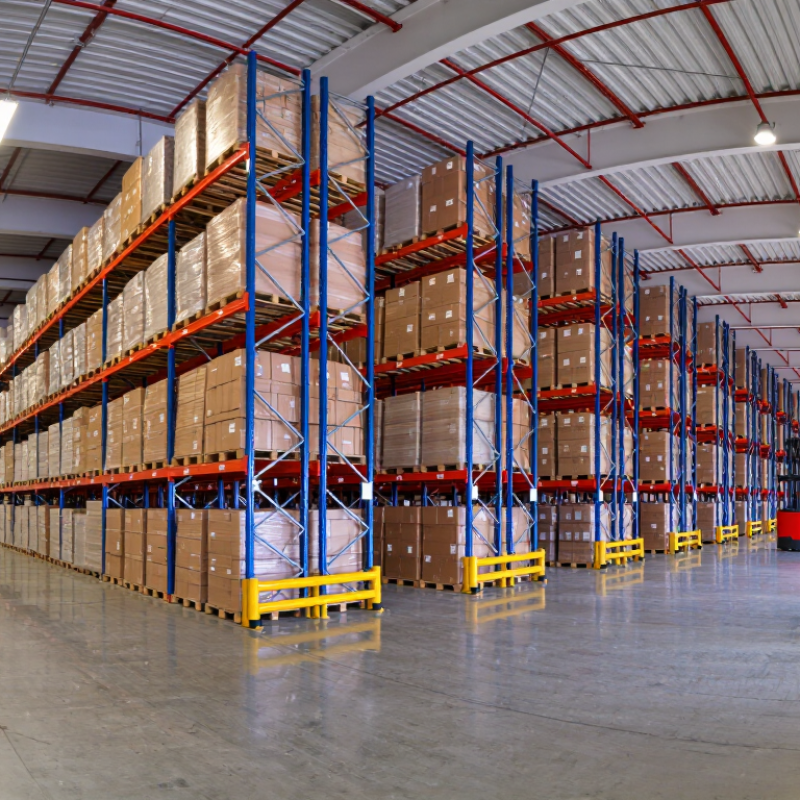
Heavy duty pallet racking stores dense, heavy loads on adjustable steel beams and upright frames. A typical bay includes uprights, beams, wire decking, column guards, and floor anchors. Selective racking offers direct access to every pallet. Drive-in systems increase density but reduce access. Push-back racking supports several pallets per lane, while pallet-flow designs improve first-in, first-out handling.
Capacity depends on beam length, steel thickness, pallet weight, load height, and seismic conditions. It also depends on forklift impact. The MHI 2024 Annual Industry Report gathered responses from more than 1,300 supply-chain professionals. Its findings highlight continuing investment in warehouse technology and operational resilience. Racking should support those goals, not merely fill available floor space. A layout may look efficient on paper. It can still create blocked aisles, poor visibility, or unsafe loading habits. OSHA Standard 1910.176 requires stable storage and clear aisles in workplaces. Local engineering rules may demand more.
Tips: Confirm the heaviest pallet first. Measure actual forklift turning space. Ask for load tables and structural calculations. Inspect anchors, beams, and guards regularly. WERC’s 2024 DC Measures report also emphasizes measurable warehouse performance, including inventory accuracy and order-cycle speed. Track both. A cheaper rack can become expensive when access slows. Paint damage matters too. Small dents deserve attention before they become larger problems.
Which Heavy Duty Pallet Racking Is Best for Global Buyers? - Heavy Duty Pallet Racking: Definition, Structure, and Main Applications
| Racking Type | Basic Structure | Typical Configuration | Storage Density | Pallet Accessibility | Main Applications | Best Choice When |
|---|---|---|---|---|---|---|
| Selective Pallet Racking | Upright frames, horizontal beams, pallet supports, and floor anchors. | Usually 2–5 pallets deep; often 2–6 storage levels, depending on building height and equipment. | Low to medium; uses conventional aisles. | Direct access to every pallet. | General warehouses, spare parts, retail distribution, manufacturing, and mixed-SKU inventory. | SKU variety and fast access are more important than maximum density. |
| Double-Deep Pallet Racking | Two selective rack rows arranged back-to-back in depth, requiring a reach truck or equivalent equipment. | Usually four pallet positions deep across two back-to-back rows. | Medium to high; fewer aisles than selective storage. | Direct access to the front pallet; rear pallets have limited access. | Food and beverage, wholesale distribution, and warehouses holding several pallets per SKU. | Higher density is required while maintaining reasonable selectivity. |
| Drive-In Pallet Racking | Structural rails create deep storage lanes, allowing forklifts to enter the rack structure. | Multiple pallets deep and several levels high; commonly configured as last-in, first-out storage. | High; minimizes aisles and maximizes cube utilization. | Limited; usually one access side per lane. | Cold storage, bulk storage, seasonal goods, and products with low SKU variety. | Storage density is the primary objective and inventory rotation is less critical. |
| Push-Back Pallet Racking | Inclined rails or carts allow pallets to move backward when a new pallet is loaded from the front. | Typically 2–6 pallets deep and multiple levels high. | Medium to high; reduces aisle requirements. | Front access only, with multiple pallets stored per lane. | High-volume goods, batch storage, consumer products, and distribution centers. | High density and faster loading are needed without forklift entry into the lanes. |
| Pallet Flow Racking | Inclined roller lanes use gravity to move pallets from the loading side toward the picking side. | Usually designed for first-in, first-out inventory rotation; lane depth varies by warehouse plan. | High; combines deep storage with controlled product movement. | Separate loading and picking faces provide good operational flow. | Perishable food, pharmaceuticals, beverages, and date-sensitive inventory. | FIFO rotation, order speed, and reduced product handling are essential. |
| Mobile Pallet Racking | Rack rows are mounted on motorized bases that move along floor rails to open a working aisle. | Often based on selective rack modules, with one or more mobile rows. | Very high; only the required aisle is opened when needed. | High, but access is sequential through the opened aisle. | Cold rooms, archives, high-value inventory, and space-constrained facilities. | Floor area is expensive or limited, and controlled access justifies a higher system cost. |
FAQS
Measure actual pallet weight, beam span, storage height, and forklift impact. A tested load table matters more than a sales claim. Capacity can drop after damage or uneven loading.
Measure clear height, aisle width, column spacing, floor flatness, and sprinkler clearance.
Not always. Oversized frames may waste floor space and reduce picking access. Compare usable pallet positions, adjustment options, and handling efficiency. More steel is not automatically better.
Selective racking gives direct access to each pallet. Deeper systems increase density but may slow rotation and picking. That trade-off is easy to underestimate.
Mark every beam with its safe working load. Display clear load notices and keep inspection records. Replace damaged components promptly, even when damage looks minor.
Galvanized finishes usually resist humid conditions better than basic painted surfaces. High-strength steel can reduce member weight. Poor welding or coating still creates risk.
Request load-test evidence, installation drawings, anchoring details, and material certificates. Confirm whether stated capacities include safety factors. Check replacement-part availability before purchasing.
Review seismic, wind, floor, anchoring, and fire-clearance conditions locally. International guidance is useful, but it is not interchangeable. A qualified engineer should confirm the final design.
Use an independent inspector to check anchors, bracing, beams, and floor conditions. Photograph damaged uprights during site trials and monthly inspections. Our estimate may still be wrong.
Compare installation quality, usable positions, safety controls, maintenance needs, and future adjustments. Do not compare price per frame alone. A cheaper system may cost more later.
Conclusion
Heavy Duty Pallet Racking is a robust warehouse storage solution designed to hold large, heavy, and frequently handled palletized goods. This article explains its basic structure, including upright frames, beams, bracing, and load-support components, as well as its main applications in distribution centers, manufacturing facilities, and logistics operations. It compares common racking types, such as selective, drive-in, double-deep, and adjustable systems, showing how each suits different requirements for storage density, product rotation, and forklift access.
The guide also presents a practical method for evaluating load capacity, rack dimensions, safety features, accessibility, material quality, and installation conditions. It highlights the importance of adapting designs to local warehouse layouts, operating practices, environmental conditions, and recognized international standards. By considering customization, future expansion, maintenance, and total operating efficiency, global buyers can select a reliable racking system that balances capacity, accessibility, safety, and long-term value.