0%

A warehouse can look full while still wasting valuable floor space. Double Deep Pallet Racking places two pallet positions behind each other, increasing storage density while reducing direct access to some loads. That trade-off matters. It can suit facilities with fewer stock-keeping units and several pallets per SKU, but it may slow picking when each pallet needs immediate access.

MHI’s 2024 Annual Industry Report tracks ongoing investment in inventory and network optimization, reflecting the pressure to use warehouse space and labor more effectively. For site-level planning, warehouse-management author Gwynne Richards emphasizes a practical principle: storage choices should fit product flow and handling methods, not capacity targets alone. That is a paraphrase of his broader guidance, not a direct quotation. Double Deep Pallet Racking typically requires a suitable double-reach truck, compatible aisle dimensions, and disciplined location control. A blocked rear pallet is not just a drawing detail. It can affect replenishment time, forklift travel, and inventory rotation.

This 2026 guide compares leading systems by access, usable capacity, equipment needs, safety features, and long-term operating costs. Results vary. Any density gain depends on the building layout, pallet size, and SKU mix; a site survey should confirm the numbers before purchase. I would also challenge one common assumption: more pallet positions do not always mean a better warehouse. The right system makes stored goods easier to manage, not merely harder to see.
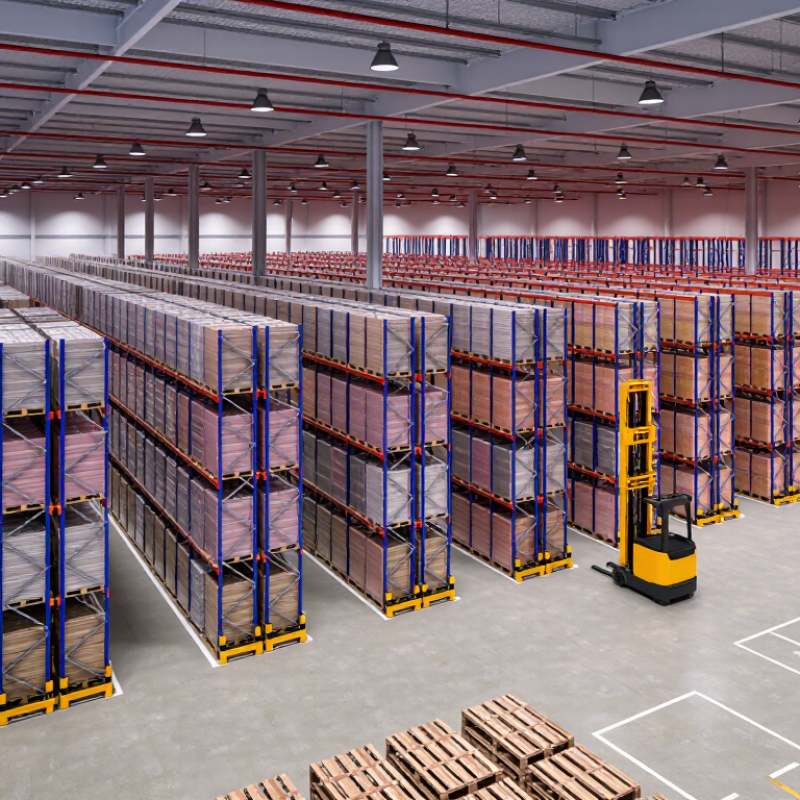
2026 Best Double Deep Pallet Racking System for Warehouses

Double Deep Pallet Racking Explained: Two Pallets Stored Deep per Lane

Double-deep pallet racking places two pallets behind one another in each storage lane. The front pallet occupies the accessible position; the rear pallet sits directly behind it. This layout increases storage density by using less aisle space than many single-deep arrangements. But the rear pallet is not immediately reachable.

A suitable double-reach forklift is generally needed to place and retrieve loads at both depths. Operators must move the front pallet before accessing the rear one, so the system works best when each lane holds the same product and stock rotates predictably. It can be less convenient for mixed inventory or frequent, random picking. That trade-off matters. Before installation, check pallet dimensions, load weights, rack ratings, floor conditions, and equipment clearances with qualified professionals. Real warehouse measurements can differ from drawings.

Tips: Keep rear and front pallets clearly identified in the inventory system. Train operators to position loads evenly and avoid damaging uprights. Measure twice. A small clearance error can make everyday handling awkward. Double-deep storage can improve capacity, but it is not automatically the best choice for every warehouse.

How Double Deep Layouts Can Add an Estimated 30–40% More Pallet Positions

2026 Best Double Deep Pallet Racking System for Warehouses

How Double Deep Layouts Can Add an Estimated 30–40% More Pallet Positions

Double-deep racking stores pallets two positions deep, reducing the number of aisles needed. In a suitable warehouse, this layout may add an estimated 30–40% more pallet positions than comparable selective racking. The gain is not guaranteed. It depends on aisle width, column spacing, pallet dimensions, and required clearances. A layout drawing should compare actual usable positions, not just rack rows. Count carefully.

MHI’s 2024 Annual Industry Report, produced with Deloitte, found that 55% of surveyed supply-chain leaders planned to increase technology investment. That broader shift makes accurate warehouse planning more valuable, but it does not prove any particular rack layout will deliver a specific gain. Double-deep systems also require suitable reach trucks, and operators have less direct access to rear pallets. That can slow picking when many SKUs need frequent access. Measure first.

For example, a warehouse holding steady quantities of a few products may benefit more than one handling many fast-changing SKUs. Review pick frequency, pallet rotation, and replenishment routes before committing. Check the plan against sprinkler clearances and truck turning paths, too. These details can reduce the headline capacity estimate. The estimate is useful, but it deserves scrutiny.

Reach Trucks and 50% Front-Position Access: Equipment and Selectivity

Double-deep pallet racking stores two pallets behind each other, increasing capacity without expanding the building. The trade-off is easy to understate: the rear pallet is not directly accessible from the aisle. With front-position access, operators can reach only the front pallet in each pair without moving another load. This can mean roughly 50% direct access, depending on the layout and stock mix. Fast-moving goods may suit the front positions; slower, compatible stock can occupy the rear. A tidy plan on paper can still create delays when picking patterns change.

Reach trucks need suitable reach capability and enough aisle clearance to handle the rack depth safely. Check the truck’s rated capacity at the required lift height and reach, not just its headline capacity. Pallet dimensions, load overhang, floor condition, and beam clearance also matter. Confirm these details with the equipment supplier and a qualified rack designer before installation. Double-deep storage can improve space use, but it reduces selectivity and may increase pallet shuffling. That compromise deserves a careful review.

Tips: Assign paired positions to the same product where practical. Keep high-turnover pallets in front, and track relocations during a trial period. Measure twice. If operators repeatedly move front pallets to reach rear stock, revise the slotting plan rather than assuming the system is working efficiently.

2026 Best Double Deep Pallet Racking System for Warehouses - Reach Trucks and 50% Front-Position Access: Equipment and Selectivity

Category Metric Typical Planning Figure Operational Meaning
Storage configuration Pallet depth Two pallet positions deep per lane The rear pallet sits behind the front pallet. Access to the rear position requires moving the front pallet first.
Selectivity Immediately accessible positions About 50% of positions in a fully occupied double-deep lane Each lane has one front position for every rear position. This is a position-access estimate, not a guarantee that 50% of all stored SKUs can be picked directly.
Pallet example Common pallet footprint 1,200 × 1,000 mm or 1,200 × 800 mm Confirm pallet orientation, load overhang, and pallet condition before finalizing rack beam lengths and clearances.
Load planning Illustrative unit load 1,000 kg per pallet, as a planning example Actual allowable load depends on the rack design, beam and upright specifications, load distribution, and applicable local requirements.
Required equipment Truck type Reach truck with a pantograph or telescopic fork mechanism The mechanism extends forks to place and retrieve pallets in the rear position. Confirm the truck’s rated capacity at the required lift height and reach.
Aisle planning Working aisle width Often approximately 3.0–3.5 m for reach-truck layouts This is a preliminary planning range only. The required aisle depends on the specific truck, pallet dimensions, load handling clearance, and operating rules.
Rack depth Two-deep storage depth Approximately two pallet depths plus designed clearances For a 1,200 mm-deep pallet, the two pallet positions alone account for about 2,400 mm. Rack, flue, and handling clearances must be engineered for the actual layout.
Illustrative capacity 10 bays × 4 levels × 2 positions across × 2 deep 160 pallet positions total; about 80 front positions Assumes every bay and level has two pallet positions across and two positions deep. The 80 rear positions are not directly accessible until their corresponding front pallets are moved.
Density trade-off Positions versus selectivity More positions per rack row than single-deep storage; lower direct access Double-deep storage can improve space utilization, but the actual gain depends on aisle count, building geometry, rack height, and the number of compatible pallet loads.
Inventory suitability Best-fit stock profile Multiple pallets per SKU, with manageable rotation requirements Works best when front and rear pallets in a lane can be assigned to the same SKU or managed with a clear replenishment and picking sequence.
FIFO / LIFO Typical lane behavior Generally suited to LIFO access within each lane Because the front pallet blocks the rear pallet, double-deep storage is not inherently a FIFO system. Stock rotation procedures should match the product’s shelf-life requirements.
Design checks Before installation Verify loads, floor, clearances, truck, and protection Have a qualified rack designer confirm structural loads, slab suitability, seismic and local code requirements, truck compatibility, sprinkler clearances, and impact protection.

Planning note: Figures are typical preliminary planning references, not universal specifications. Final capacity, aisle width, clearances, and rack configuration should be verified against the actual warehouse, pallets, reach truck, and applicable regulations.

Rack Design Checks: Load Capacity, Aisle Width, Clearances, and Floor Conditions

2026 Best Double Deep Pallet Racking System for Warehouses

Double-deep racking can increase storage density, but every design check must reflect the actual forklift, pallet, and building. Record the maximum unit load, including pallet weight, and calculate beam and upright loads for each rack level. ANSI/RMI MH16.1-2021 provides the structural design basis for industrial steel storage racks. Do not use a “typical pallet” estimate. A heavier load can change the whole bay.

Aisle width should come from the selected truck’s right-angle stacking dimension, load length, and operating clearance—not a generic warehouse diagram. Measure the truck with the actual load, then confirm turning space at aisle ends. Check rack-to-rack and rack-to-wall clearances against the equipment supplier’s requirements. NFPA 13 (2022) commonly requires at least 18 inches between standard spray sprinkler deflectors and stored goods, but sprinkler type and layout can change the applicable clearance. Verify it on the fire-protection drawings.

Floor conditions matter. Review slab capacity, joints, cracks, and levelness with a qualified structural engineer; a smooth-looking floor may still have weak spots near saw cuts. ACI 360R-10 discusses slab-on-ground design, but it does not replace a site-specific assessment. One easy detail to miss: loaded rack legs may sit close to a joint. Map them before installation, and reconsider the layout if measurements are uncertain.

2026 Best Double Deep Pallet Racking System for Warehouses

Rack Design Checks: Load Capacity, Aisle Width, Clearances, and Floor Conditions

Illustrative load check: Two pallet positions deep at 1,000 kg per loaded pallet equal 2,000 kg per beam level. Across three loaded beam levels, the example bay stores 6,000 kg of pallet load. These figures are an arithmetic example, not a rack rating. Confirm allowable loads with a qualified rack designer using the actual frame, beams, connections, pallet loads, and layout. Set aisle width to suit the selected truck and load; verify operating clearances against approved drawings; and check the floor’s capacity, condition, levelness, and anchorage requirements before installation.

2026 Selection Criteria: Inventory Profile, Safety Standards, and Total Cost of Ownership

Double-deep pallet racking can add storage positions without expanding a warehouse footprint, but it changes how inventory is accessed. Start with the inventory profile: record pallet dimensions, weights, SKU counts, and weekly picking frequency. Access matters. Fast-moving or date-sensitive goods may not suit lanes where pallets sit behind other pallets. A deeper system can reduce selectivity, so compare the space gain with the extra handling time.

Review safety requirements before approving a layout. Confirm that the floor can support the planned loads and that each beam level has a clear capacity rating. Check aisle widths, rack protection, and clearance for the reach truck used to retrieve rear pallets. Inspection procedures should identify bent uprights, loose components, and impact damage early. Local codes and site conditions vary; have a qualified professional verify the final design rather than relying on a generic drawing.

Compare total cost of ownership, not just the rack quote. Include installation, suitable handling equipment, operator training, inspections, repairs, and possible changes to picking labor. Measure twice. A small throughput trial can reveal whether retrieval times match the forecast. Our assumptions may still be wrong: order patterns shift, and a dense layout can become awkward when the SKU mix changes. Keep flexibility in the cost model, especially if inventory turns or pallet sizes are uncertain.

FAQS

What is double-deep pallet racking?

It stores two pallets in each lane, one behind the other. The front pallet blocks direct access to the rear pallet.

What equipment is generally needed?

A double-reach forklift is generally needed to place and retrieve pallets at both depths. Check its clearances against the actual rack layout.

Which inventory works best in this system?

It suits lanes holding the same product, with predictable stock rotation. Mixed items and frequent random picking can make retrieval awkward.

Does double-deep storage increase warehouse capacity?

It can add storage positions while using less aisle space than many single-deep layouts. Access is slower. The space gain may come with extra handling time.

What measurements should be checked before installation?

Check pallet dimensions, load weights, rack ratings, floor conditions, aisle widths, and equipment clearances. Drawings can differ from the real warehouse.

What safety details need attention?

Confirm floor capacity and clear beam ratings. Inspect for bent uprights, loose components, and impact damage. Small damage matters.

What costs should be included?

Consider installation, handling equipment, operator training, inspections, repairs, and changes to picking labor. A low rack quote may not show the full cost.

How can a warehouse test whether the layout will work?

Run a small throughput trial and measure retrieval times. Track front and rear pallets clearly. Forecasts can be wrong when order patterns change.

Conclusion

Double Deep Pallet Racking stores two pallets deep in each lane, making better use of warehouse floor space and potentially adding an estimated 30–40% more pallet positions compared with a single-deep layout. This density comes with a trade-off: only the front pallet in each lane is directly accessible, so roughly 50% of pallet positions are immediately reachable. Reach trucks designed for double-deep handling can access the rear positions, but operations should account for the added equipment requirements and reduced selectivity.

Choosing a system in 2026 means matching the layout to inventory turnover, pallet dimensions, and handling practices. Before installation, verify rack load capacity, aisle width, operating clearances, and floor condition. Also consider applicable safety standards, inspection and maintenance needs, and the total cost of ownership, including equipment and operational costs. Double Deep Pallet Racking is most suitable when storage density is a priority and inventory can be managed to suit its access pattern.

Vivian

Vivian

Vivian is a professional marketing specialist dedicated to helping businesses understand products, markets, and practical solutions through clear, reliable, and engaging content. With a strong knowledge of the company’s product portfolio, industry applications, and customer needs, Vivian regularly......